
Customs Today
  • Home
  • Islamabad
  • Karachi
  • Lahore
  • National
  • Transfers and Postings
  • Chambers & Associations
  • Business
No Result
View All Result
Customs Today
  • Home
  • Islamabad
  • Karachi
  • Lahore
  • National
  • Transfers and Postings
  • Chambers & Associations
  • Business
No Result
View All Result
Customs Today
No Result
View All Result
Home Science & Technology Science

Fast radio burst sheds light on origin of these extreme events

bySana Anwar
04/12/2015
in Science, Science & Technology
Share on FacebookShare on Twitter

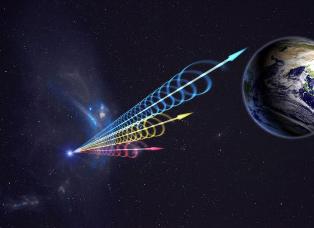
CANADA: Scientists are likely closer to knowing the origins of short blasts of cosmic radio waves that have baffled them since almost a decade earlier.

New research sheds light on these mysterious pulses called fast radio bursts (FRBs), which probably originated from a highly magnetized region of space and linked to a recent supernova. The blast was recorded by the Green Bank Telescope of the National Science Foundation, which offered more than 650 hours of data.


You might also like

Tesla driverless system to use updated radar technology

12/09/2016

Apple to develop its own self-driving technology

10/09/2016

Astronomer Kiyoshi Masui from the University of British Columbia said that the energy from the newly identified FRB 110523 went through a dense and magnetized region shortly following its formation.

“This significantly narrows down the source’s environment and type of event that triggered the burst,” he said in a release.

FRBs last only a fraction of a second yet pack staggering amounts of energy. They appear to hail randomly from the sky and are believed to strike the universe by the thousands every day.

One challenge in analyzing data is that a rapid, sharp FRB signal becomes “smeared out” in frequency by its space journey. The radio signal smearing is referred to as dispersion delay. In the research, the dispersion measure estimated that the radio blast came from as far as 6 billion light-years away.

Masui and his team’s new highly specialized software reduced the time for data analysis through countering dispersion, which masks an FRB’s presence within archival radio data. An initial pass of the data yielded over 6,000 potential FRBs, which were individually appraised until FRB 110523 remained.


Related Stories

Tesla driverless system to use updated radar technology

byCT Report
12/09/2016

WASHINGTON: Electric carmaker Tesla announced Sunday it was upgrading its Autopilot software to use more advanced radar technology. In a...

Apple to develop its own self-driving technology

byCT Report
10/09/2016

SAN FRANCISCO: Apple may not become an automaker, but it still wants to develop its own self-driving technology. The iPhone-maker's...

NASA spots slowest known magnetar

byCT Report
10/09/2016

WASHINGTON: Astronomers have found evidence of a magnetar - magnetised neutron star - that spins much slower than the slowest...

‘YouTubers’ outshining old-school television

byCT Report
09/08/2016

SAN FRANCISCO: A media revolution is taking place, and most people over 35 years of age aren’t tuned in. Millennial...

Next Post

Mount Everest glacial lakes expand due to Nepal’s previous earthquake, researchers

  • Terms and Conditions
  • Disclaimer

© 2011 Customs Today -World's first newspaper on customs. Customs Today.

No Result
View All Result
  • Transfers and Postings
  • Latest News
  • Karachi
  • Islamabad
  • Lahore
  • National
  • Chambers & Associations
  • Business
  • About Us

© 2011 Customs Today -World's first newspaper on customs. Customs Today.