
Customs Today
  • Home
  • Islamabad
  • Karachi
  • Lahore
  • National
  • Transfers and Postings
  • Chambers & Associations
  • Business
No Result
View All Result
Customs Today
  • Home
  • Islamabad
  • Karachi
  • Lahore
  • National
  • Transfers and Postings
  • Chambers & Associations
  • Business
No Result
View All Result
Customs Today
No Result
View All Result
Home Ports and Shipping

Port terminals “the weak link” in global supply chains: TT Club

byCT Report
20/12/2015
in Ports and Shipping
Share on FacebookShare on Twitter

You might also like

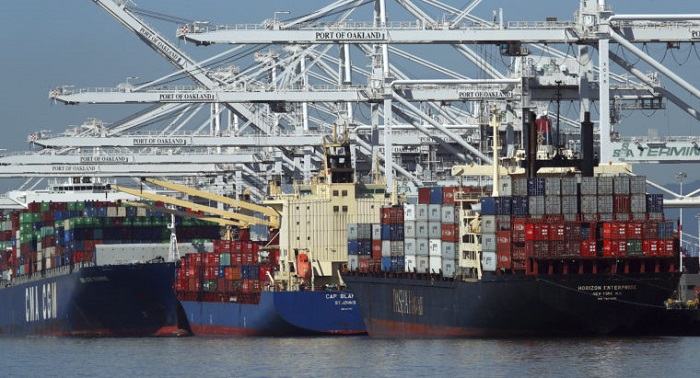
Container ships wait to be unloaded at the Port of Oakland on Wednesday, March 7, 2018, in Oakland, Calif. The U.S. trade deficit rose in January to the highest level since October 2008, defying President Donald Trump's efforts to bring more balance to America's trade with the rest of the world, the Commerce Department said Wednesday. (AP Photo/Ben Margot)

Shipping activity at Port Qasim on February 11

11/02/2021

KPT ships movement, cargo handling report Feb 10

09/02/2021

LONDON: As pivotal hubs within global trade, container ports and terminals face risks that have potentially serious consequences for international supply chains.
At a recent speech to the TOC Middle East Conference in Dubai, Julien Horn, of TT Club, took the opportunity to outline such risks.
He highlighted the lessons to be learned from recent incidents such as the explosion at Tianjin and the increasing occurrence of cyber crime at port facilities.
Fire and theft consistently lead the list of causes in TT Club’s on-going analysis of claims it receives, which is used as a focus for loss prevention in relation to the damaging consequences to life, property, supply chain stability and business reputation, being a primary role of the insurance provider. Such advice formed the core of Horn’s presentation in Dubai.
“Port terminals are often seen as the weak link in global supply chains. Clearly as cargo shifts from one mode to another and is stored for a period of time, operationally it becomes more susceptible to risk. Greater preventative measures must therefore be employed here. This is particularly true in the Middle East region where rapid trade growth and aggressive port expansion continue at rates higher than in other parts of the world,” said Horn.
The serious incident in Tianjin last August clearly brought into focus the dangers on which TT Club habitually issues warnings. Recent IMO statistics point to some 15% of dangerous goods shipments being in some way deficient in safety measures and the declaration, packing and handling of such cargoes must be of primary concern to terminal operators. Horn cited a number of problems in need of attention, including poor practices for cargo segregation, lack of adequate storage facilities for dangerous goods, inadequate training in sound practice and lack of coordination with fire & rescue services.
With regard to the escalating incidence of cyber crime, Horn commented, “A PwC report in 2013 revealed that 11% of companies worldwide lost over US$50,000 as a result of cyber crime and there is evidence that the peril has become much worse over the last two years.”
Reliance on IT systems for data storage and communication will not diminish and the supply chain by its very nature is more exposed than other areas of commerce to such risk.
“In common with prevention of all operational risk, our advice to combat such threats,” concluded Horn, “Includes a constant awareness of the dangers of infiltration into IT systems, vigilant data protection, careful staff background checks and training, planning for the consequences of a compromised system and immediate reaction to such an event.”
Tags: Port terminals “the weak link” in global supply chains: TT Club

Related Stories

Container ships wait to be unloaded at the Port of Oakland on Wednesday, March 7, 2018, in Oakland, Calif. The U.S. trade deficit rose in January to the highest level since October 2008, defying President Donald Trump's efforts to bring more balance to America's trade with the rest of the world, the Commerce Department said Wednesday. (AP Photo/Ben Margot)

Shipping activity at Port Qasim on February 11

byCT Report
11/02/2021

KARACHI: Three ships namely, Glen Canyon, Al-Salam- II and TSM Pollux carrying Containers, Gas oil and Palm oil were arranged...

KPT ships movement, cargo handling report Feb 10

byCT Report
09/02/2021

KARACH: Following were the movements of ships and cargo handling at the Karachi Port Trust (KPT) during the last 24...

Container ships wait to be unloaded at the Port of Oakland on Wednesday, March 7, 2018, in Oakland, Calif. The U.S. trade deficit rose in January to the highest level since October 2008, defying President Donald Trump's efforts to bring more balance to America's trade with the rest of the world, the Commerce Department said Wednesday. (AP Photo/Ben Margot)

Shipping activity at Port Qasim on January 8

byCT Report
08/02/2021

KARACHI: Five ships namely, Diyala, MSC Jasmine, Stena Image, BW Danube, Goral Frost and carrying Containers, Palm oil, Mogas and...

Container ships wait to be unloaded at the Port of Oakland on Wednesday, March 7, 2018, in Oakland, Calif. The U.S. trade deficit rose in January to the highest level since October 2008, defying President Donald Trump's efforts to bring more balance to America's trade with the rest of the world, the Commerce Department said Wednesday. (AP Photo/Ben Margot)

Shipping activity at Port Qasim Feb 3

byCT Report
03/02/2021

KARACHI: Three ships namely, Maersk Detroit, Aye Evolution and Yufu Crown carrying Containers, Coal and Gas oil were allotted berths...

Next Post

Canada: Port of Montreal welcomes Hapag-Lloyd on its first call to Montreal

  • Terms and Conditions
  • Disclaimer

© 2011 Customs Today -World's first newspaper on customs. Customs Today.

No Result
View All Result
  • Transfers and Postings
  • Latest News
  • Karachi
  • Islamabad
  • Lahore
  • National
  • Chambers & Associations
  • Business
  • About Us

© 2011 Customs Today -World's first newspaper on customs. Customs Today.