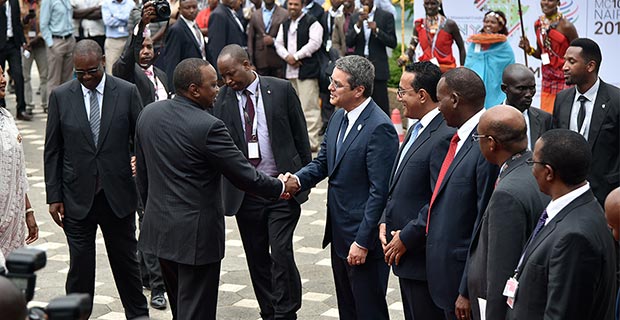
ADDIS ABABA: Africa’s trade negotiators gathered in Nairobi, last week saw the 10th Ministerial Summit of the World Trade Organization (WTO) as a moment of “do or die.” Trade ministers across the world were there to negotiate issues of multilateral trade relationships using a platform Amina Mohammed, cabinet secretary of Foreign Affairs & International Trade of the host country, said is “broken.”
African trade ministers were afraid this broken system would not address their issues of concern, had the ministerial closed on Friday, December 18, 2015, without reaffirming rich countries’ commitment to the Doha Development Agenda (DDA). Indeed, long and frustrating hours of talks stretched to the deep hours of the night and bore no fruit, causing the closing session to be postponed to Saturday, Fortune’s press time.
Fourteen years ago, countries which are members of WTO agreed in Doha, Qatar, to include economic development of poor countries in trade talks, giving particular emphasis to agriculture. No concluding outcome has been achieved on this issue since then, despite subsequent ministerial summits from Cancun, Mexico, in the early 2000s, to Bali, Indonesia, two years ago.
African trade negotiators were worried last week that the world had travelled to Nairobi to bury this agenda, before any agreeable solution to their plights.
Africa should focus in modernizing its agriculture; and its ambitions to advance industrial strategy based on value addition should not be compromised by a WTO ministerial declaration, warned a Trade Minister of Rwanda, in Nairobi. His was a voice echoed by his colleague from Mauritius.
“We want to see a WTO that is inclusive, fair and freer multilateral platform,” said the Minister.
The South African Trade Minister had wanted to see tangible deliverables from the Summit last week in the form of inclusion of what technocrats describe as a Least Developed Countries (LDC) Package, particularly with loud pronouncement on agriculture. He saw no such package presented in the draft declaration, a.k.a. the Nairobi Declaration. President Uhuru Kenyatta, whose country hosted the summit that was the first to be held on African soil since WTO was founded 20 years ago, defined the objectives of the summit as, “finding a possible landing zone and working towards convergence of the issues on the table.”
African ministers, however, wonder what it may take them to do just that.
“We want to see the ministerial succeed,” said another Trade Minister. “But at what cost?”
African voices say the cost should not be to the extent of reversing the gains developing countries won in Doha in 2001. In Nairobi they called for the “unconditional reaffirmation” of the rich countries commitment to agreements made in Doha to consider broader economic growth and development matters in their trade talks. The rich countries are about lifting trade barriers and facilitating the transfer of goods and services, issues Kenyatta called “narrower but still valuable.”
“We haven’t come to Nairobi to bury Doha,” warned the Minister from South Africa.
Failure by trade negotiators from advanced economies to listen to calls from their counterparts in the developing world would have consequences, warned African ministers. Behind closed doors, they threatened to deny any support of a deal in Nairobi which would not incorporate the Doha Development Agenda (DDA).
“Silence is golden,” said a Minister of Trade from Namibia.
That desperation may have been behind the remark made by Kenya’s Cabinet Secretary of Foreign Affairs & International Trade. She warned that WTO as a multilateral trade negotiating tool is “at a crossroad.”
To her despair, nothing in the form of reaffirmation to Doha Development Agenda came at the end of the summit on Saturday, although there were modest gains such as an agreement information technology.

Markets, oil drop in Asia but bitcoin edges towards $50,000
HONG KONG: Markets fell in Asia on Friday in holiday-thinned trade with investors awaiting developments in US stimulus talks, while...