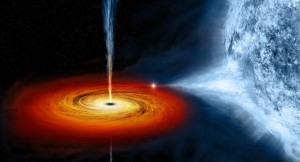
WASHINGTON: A new black hole has been discovered that is being called the second largest in Milky Way.
The astronomers have detected signs of an invisible black hole with a mass 100 thousand times that of the Sun around the centre of the Milky Way.


The team assumes that this possible “intermediate mass” black hole is a key to understanding the birth of the supermassive black holes located in the centres of galaxies.
A team of astronomers led by Tomoharu Oka, a professor at Keio University in Japan, found an enigmatic gas cloud, called CO-0.40-0.22, only 200 light years away from the centre of the Milky Way.
The CO-0.40-0.22 unusual has a surprisingly wide velocity dispersion – the cloud contains gas with a very wide range of speeds. The team found this mysterious feature with two radio telescopes, the Nobeyama 45m Radio Telescope in Japanand the ASTE Telescope in Chile, both operated by the National Astronomical Observatory of Japan.
The team observed CO-0.40-0.22 to obtain 21 emission lines from 18 molecules. The results show that the cloud has an elliptical shape and consists of two components – a compact but low density component with a very wide velocity dispersion of 100 km per second, and a dense component extending 10 light years with a narrow velocity dispersion.
There are no holes inside of the cloud. Also, X-ray and infrared observations did not find any compact objects. These features indicate that the velocity dispersion is not caused by a local energy input, such as supernova explosions.
The team performed a simple simulation of gas clouds flung by a strong gravity source. In the simulation, the gas clouds are first attracted by the source and their speeds increase as they approach it, reaching maximum at the closest point to the object.
After that the clouds continue past the object and their speeds decrease. The team found that a model using a gravity source with 100 thousand times the mass of the Sun inside an area with a radius of 0.3 light years provided the best fit to the observed data.
“Considering the fact that no compact objects are seen in X-ray or infrared observations, the best candidate for the compact massive object is a black hole,” said Oka.
This is the first detection of an intermediate mass black hole. Astronomers already know about two sizes of black holes – stellar-mass black holes, formed after the gigantic explosions of very massive stars; and supermassive black holes (SMBH) often found at the centres of galaxies.
No one knows how the SMBHs are formed. One idea is that they are formed from mergers of many intermediate mass black holes. However, so far no firm observational evidence for intermediate mass black holes has been found.
If the cloud CO-0.40-0.22, located only 200 light years away from Sagittarius A-star – the 400 million solar mass SMBH at the centre of the Milky Way – contains an intermediate mass black hole, it might support the intermediate mass black hole merger scenario of SMBH evolution.