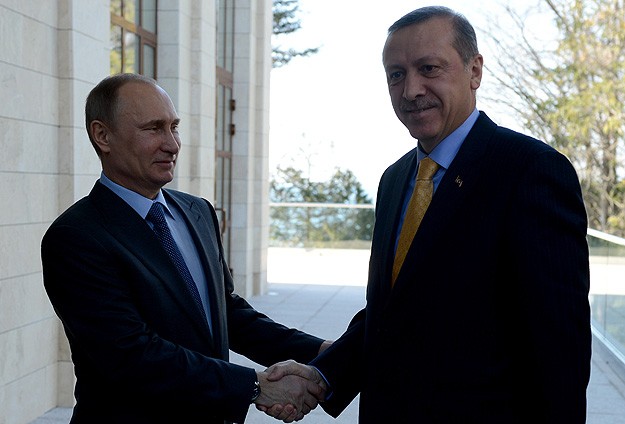
ANKARA: Relations between Moscow and Ankara, though tense at times, appear to be tentatively improving. Russia’s President Vladimir Putin and Turkish Prime Minister Recep Tayyip Erdogan meet in Sochi, Russia.
Russia and Turkey have had a long, often tumultuous relationship, and some of their difficulties are not so distant. Their current relations are of particular significance in the context of the tense confrontation between the United States, the European Union and Russia over Ukraine.


Before Moscow invaded and annexed Crimea earlier this year, Russian-Turkish relations had been on a dramatic upswing, with two-way trade reaching some $32 billion in 2013 (mostly Turkish imports of Russian natural gas) and Russia becoming Turkey’s No. 2 trading partner, behind Germany. Turkey had also emerged as Russia’s No. 1 trade partner in services, according to Russian Central Bank statistics, and the leading destination for Russian tourists (some 4 million in 2013), although recent advertisements on Russian state television is encouraging them to go to Crimea instead. Two years ago, Russia and Turkey agreed on visa-free travel for their citizens, allowing stays of one and later two to three months. Meanwhile, the EU and Turkey have established a road map for visa-free travel, but have not finalized an agreement.
On the political front, Russia and Turkey established the High Level Cooperation Council in 2010, which has met four times and may convene its fifth session in Turkey before the end of the year. Russian and Turkish officials appear to consult regularly on significant regional issues
For Russia, the advantages of an improving relationship with Turkey are powerful and multidimensional. The symbolism of Turkey’s unwillingness to join the US-European effort to isolate Moscow and to impose costs for the Kremlin’s conduct in Ukraine allows Russian leaders to assert (and to believe) that NATO is not quite as unified as some of its national leaders claim. Almost from NATO’s founding, Moscow has sought to exacerbate tensions within the alliance, a sensible geopolitical strategy that works best when Moscow is not overly provocative in its foreign policy. Given how unfavorable the current environment is in this context, Russia’s relative success with Turkey likely extends beyond mere active diplomacy to also reflect a gradual, underlying shift in Ankara’s perception of its national interests and goals as its efforts to join the EU recede.
Moscow sees Turkey as not only a key market and service provider, but also as an attractive counterterrorism partner in the strategically important Caucasus region as well as the Middle East. More fundamentally, if NATO were ever to consider military operations to restore Crimea to Ukraine — a virtual impossibility given Moscow’s nuclear deterrent, although Russia’s military planners must nevertheless consider it among their worst-case scenarios — or if Russia and NATO slid into a military conflict in Ukraine, Turkey’s well-developed NATO infrastructure would pose the most immediate threat to the peninsula and to Russia’s naval base at Sevastopol. Needless to say, Ankara’s control of access to the Black Sea from the Mediterranean would be of great significance in either situation. A Turkey unwilling to participate in such a confrontation would sharply limit NATO’s options.
Looking ahead, there is still room for growth in bilateral trade. The combination of Russia’s energy resources and Turkey’s location straddling three continents creates considerable synergies that could be appealing to Russia, not to mention that Turkey provides state-owned Gazprom with yet another route around Ukraine to Europe. Turkey also appears to share some of Moscow’s perspectives on the need to reform the international financial system to accommodate emerging economies.
For now, Moscow and Ankara appear to have found a way to compartmentalize their disagreements so they do not detract materially from their overall bilateral relationship. With Erdogan having moved from being prime minister to president and former Foreign Minister Ahmet Davutoglu taking over the premiership, Turkey seems likely to sustain its current policy toward Moscow, and Russia seems likely to reciprocate.