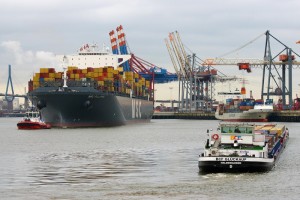
WASHINGTON: Higher bulk cargo throughput and strong growth in rail and inland waterway seaport-hinterland traffic – downturn in container handling. In 2015 seaborne cargo throughput in the Port of Hamburg was 5.4 percent lower at 137.8 million tons.
In Hamburg as a universal port, growth in bulk cargo throughput was maintained in 2015. In this important handling segment, total volume of 45.5 million tons represented growth of 5.8 percent on the previous year. In 2015 container handling at 8.8 million TEU (20-ft standard containers) did not reach the previous year’s total, falling 9.3 percent and significantly lower.

Senator Frank Horch highlighted the port’s great significance for Hamburg, warning against talking it down: “Anybody familiar with the port business will realize that the Port of Hamburg’s success cannot be measured solely in TEU. Its success is composed of many elements. What makes the Port of Hamburg strong is its character as a universal port.
The Port of Hamburg is actually one of the largest and most varied industrial zones in Germany. Cargo handling, logistics and industry are closely intermeshed here and mutually cross-fertilizing. The port consists of the sum of these numerous and multi-facetted activities, something that cannot be described by throughput figures alone. I most urgently warn you against conjuring up crises. That harms our port and plays into the hands of our competitors. For us, economic fluctuations are nothing new – they are part of our business. Nobody disputes that we are confronted by great challenges. But, together, we shall master them!”
The Port of Hamburg reports around 30 percent local container cargo as well as growing seaport-hinterland container transport by rail, up by 2.8 percent, and by inland waterway vessels, up by 27.5 percent. As an industrial universal port, it performs an outstanding and indispensable function in supplying the local economy at its location and in the region, along with core markets inland.
Downturn in seaborne container throughput is primarily attributable to lower volumes handled with China, Russia and Poland. In total, in 2015 something over 800,000 containers (TEU) fewer than in the previous year were handled for these especially important trading partners in container traffic with the Port of Hamburg.