Customs Today
  • Home
  • Islamabad
  • Karachi
  • Lahore
  • National
  • Transfers and Postings
  • Chambers & Associations
  • Business
No Result
View All Result
Customs Today
  • Home
  • Islamabad
  • Karachi
  • Lahore
  • National
  • Transfers and Postings
  • Chambers & Associations
  • Business
No Result
View All Result
Customs Today
No Result
View All Result
Home Latest News

Phosphoric reserves in China declining

byCT Report
25/02/2016
in Latest News
Share on FacebookShare on Twitter

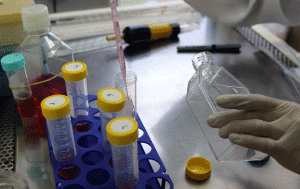
BEIJING: China’s reserves of phosphorus, a key element for growing food, could be exhausted within the next 35 years if the country maintains its current production rate, a new study has found.

However, China could delay exhausting its phosphorus reserves by more than 20 years through improving agronomic use efficiency of the mineral to the average level of 80 percent in developed countries without impairing current crop yields, said the study, published this week in the US journal Proceedings of the National Academy of Sciences.

You might also like

KP approves Finance Bill 2026-27 with new taxes, tougher penalties

27/06/2026

Pakistan honored with SCO Business Council leadership for 2027

27/06/2026

Zengwei Yuan of Nanjing University and colleagues modeled the phosphorous cycle in China since the 1600s and evaluated the mineral’s potential for eutrophication, which may lead to algal blooms, plant overcrowding and oxygen depletion.

They found China intensified its phosphorus mining, particularly during the last 60 years, to feed increasing populations and meet people’s demand for animal protein.

In 2012, China’s annual phosphorus extraction reached 12.5 million tons, accounting for more than 40 percent of the global phosphorus production, they said.

About 70 percent of the domestically exploited phosphorus was used to produce synthetic fertilizers.

The study revealed phosphorus over-application by Chinese farmers.

In 2012, China’s crop production saw an average use of 80 kilograms of phosphorus per hectare, more than double the figure that crops can generally assimilate and far higher than the average level of the developed countries.

Meanwhile, only 4 percent of natural phosphorus resources were eventually ingested by Chinese residents in 2012, slightly lower than the 5 percent in the United States.

The researchers also found China has become a net phosphorus exporter since 2003, exporting mainly phosphorus-containing chemicals such as fertilizers and pesticides, while importing crops, specifically soybeans from the US, Brazil and Argentina.

As a result, phosphorous accumulated rapidly in China’s surface waters and lands in the last decade.

Related Stories

KP approves Finance Bill 2026-27 with new taxes, tougher penalties

byCT Report
27/06/2026

PESHAWAR: The Khyber Pakhtunkhwa government has approved the Finance Bill for fiscal year 2026-27, introducing significant increases in provincial taxes...

Pakistan honored with SCO Business Council leadership for 2027

byCT Report
27/06/2026

ARACHI: Atif Ikram Shiekh, President of the Federation of Pakistan Chambers of Commerce and Industry (FPCCI), has attended the Shanghai...

Pakistan, Iran push for rail and road connectivity to unlock bilateral trade

byCT Report
27/06/2026

LAHORE: Pakistan and Iran have agreed to accelerate efforts to improve cross-border transportation networks, with both countries identifying stronger road...

SHC declares FBR officers’ appointment to monitor private business null & void

byCT Report
27/06/2026

KARACHI: The Sindh High Court (SHC) on Saturday declared a Federal Board of Revenue (FBR) office order appointing officers to...

Next Post

China becomes world's second-largest R&D performer

  • Terms and Conditions
  • Disclaimer

© 2011 Customs Today -World's first newspaper on customs. Customs Today.

No Result
View All Result
  • Transfers and Postings
  • Latest News
  • Karachi
  • Islamabad
  • Lahore
  • National
  • Chambers & Associations
  • Business
  • About Us

© 2011 Customs Today -World's first newspaper on customs. Customs Today.