Customs Today
  • Home
  • Islamabad
  • Karachi
  • Lahore
  • National
  • Transfers and Postings
  • Chambers & Associations
  • Business
No Result
View All Result
Customs Today
  • Home
  • Islamabad
  • Karachi
  • Lahore
  • National
  • Transfers and Postings
  • Chambers & Associations
  • Business
No Result
View All Result
Customs Today
No Result
View All Result
Home Science & Technology Science

Two new subatomic particles can help understand universe

byCustoms Today Report
20/11/2014
in Science, Science & Technology
Share on FacebookShare on Twitter

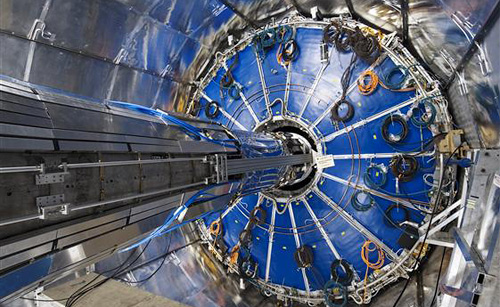
EUROPE: The Scientists of CERN are announced on Wednesday that two new subatomic particles could extend our understanding of the universe have been discovered. The cooperation for the LHCb research at CERN’s Large Hadron Collider discovered the two new particles belonging to the baryon family.

A baryon is a composite subatomic particle made up of three quarks.

You might also like

Tesla driverless system to use updated radar technology

12/09/2016

Apple to develop its own self-driving technology

10/09/2016

The particles were predicted to exist by the quark model but had never been seen before. A related particle was found by the CMS experiment at CERN in 2012.

Like the well-known protons that the LHC accelerates, the new particles are baryons made from three quarks bound together by the strong force.

The types of quarks are different, though: the new particles both contain one beauty (b), one strange (s), and one down (d) quark, CERN said in a statement.

Thanks to the heavyweight b quarks, they are more than six times as massive as the proton. But the particles are more than just the sum of their parts: their mass also depends on how they are configured.

“Nature was kind and gave us two particles for the price of one,” said Matthew Charles of the CNRS’s LPNHE laboratory at Paris VI University.

As well as the masses of these particles, the research team studied their relative production rates, their widths — a measure of how unstable they are — and other details of their decays.

The results match up with predictions based on the theory of Quantum Chromodynamics (QCD), researchers said.

QCD is part of the Standard Model of particle physics, the theory that describes the fundamental particles of matter, how they interact and the forces between them.


 

Tags: CERNCMS experiment at CERNHadron ColliderLHCLPNHEnew subatomic particles exposed

Related Stories

Tesla driverless system to use updated radar technology

byCT Report
12/09/2016

WASHINGTON: Electric carmaker Tesla announced Sunday it was upgrading its Autopilot software to use more advanced radar technology. In a...

Apple to develop its own self-driving technology

byCT Report
10/09/2016

SAN FRANCISCO: Apple may not become an automaker, but it still wants to develop its own self-driving technology. The iPhone-maker's...

NASA spots slowest known magnetar

byCT Report
10/09/2016

WASHINGTON: Astronomers have found evidence of a magnetar - magnetised neutron star - that spins much slower than the slowest...

‘YouTubers’ outshining old-school television

byCT Report
09/08/2016

SAN FRANCISCO: A media revolution is taking place, and most people over 35 years of age aren’t tuned in. Millennial...

Next Post

400 horsepower new Toyota Supra more costly than $55,000 Corvette Stingray

  • Terms and Conditions
  • Disclaimer

© 2011 Customs Today -World's first newspaper on customs. Customs Today.

No Result
View All Result
  • Transfers and Postings
  • Latest News
  • Karachi
  • Islamabad
  • Lahore
  • National
  • Chambers & Associations
  • Business
  • About Us

© 2011 Customs Today -World's first newspaper on customs. Customs Today.