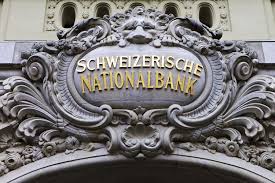
ZURICH: Switzerland’s central bank held its negative interest rates steady despite the expanded stimulus package from the European Central Bank which may eventually put renewed upward pressure on the Swiss franc against the euro.
The decision, which was widely expected by economists, highlights the challenge faced by Swiss central bankers who confront a strong currency and falling consumer prices but with limited scope of ease policy much further.


The Swiss National Bank kept a key deposit rate at -0.75% on Thursday, saying it would continue to intervene in the currency markets to weaken the franc which remains “significantly overvalued.”
It also held its target range for the three month London interbank offered rate, or Libor, at -1.25% to -0.25%, in line with expectations from economists.
“Against this background, the negative interest rate and the SNB’s willingness to intervene in the foreign exchange market serve to ease pressure on the Swiss franc,” the monetary authority said.
Negative interest rates are intended to weaken demand for the franc by making it less attractive to foreign investors which have long favored the currency as a haven in times of volatile global markets. Negative rates are also intended to bolster economic growth by encouraging banks to lend more to consumers and businesses.
The franc spiked in value in a knee-jerk response by investors after SNB scrapped a 3½ year policy of putting a cap on the currency, limiting it to 1.20 francs to the euro, though it softened somewhat as the year progressed. The euro traded at just under 1.10 against the franc midday Thursday.
Although the ECB significantly beefed up its stimulus programs last week, adding to asset purchases and cutting its already negative deposit rate, the bank’s president Mario Draghi signaled that rates were
unlikely to be reduced further. That kept the euro from weakening against the franc, a key factor for Switzerland’s export-dependent economy.
Analysts said the euro would need to weaken further against the franc from its current level near 1.10 to around 1.05 to 1.07 before raising alarm bells at the SNB. Although volatility in financial markets at the start of 2016 didn’t result in big gains for the franc, a number of factors including scaled-back expectations for Federal Reserve rate increases or uncertainties surrounding the U.K. future as a member of the European Union could increase demand for the Swiss currency.
‘The global economic outlook has deteriorated slightly in recent months and the situation on international financial markets remains volatile.’
Alexander Koch, economist at Bank Raiffeisen, said the SNB would probably prefer to intervene on currency markets just to fine-tune the exchange rate, and would want to avoid imposing a minus 1% deposit rate.
So far, financial institutions in Switzerland have shielded their retail depositors from negative deposit rates, even as the institutions themselves must pay the SNB for deposits over a certain threshold. But the longer that negative policy rates from the SNB persist, or if they are cut even more, the more pressure commercial banks will come under to pass the costs along to customers.
Negative rates “are painful for banks and the pension system,” said Ursina Kubli, economist at J. Safra Sarasin.
Some analysts said, however, that if the ECB reduces its minus 0.4% deposit rate further, then the SNB might be forced to follow suit.
The SNB lowered its forecast for the Swiss economy to grow this year of between 1% and 1.5%, down from its last forecast of 1.5% in December. Earlier Thursday, the Swiss government said its expert group projects economic growth of 1.4% this year and 1.8% in 2017.
The SNB said that while it expects consumer prices to fall again this year, by 0.8%, Switzerland should emerge from several years of deflation next year. The SNB expects consumer prices to rise 0.1% in 2017 and 0.9% in 2018.