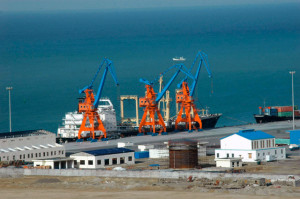
GWADAR: A 30-by-45-foot Chinese flag draping the port authority building here projects an unmistakable message: Pakistan and China are now self-declared “iron brothers” and “all-weather friends.” Underpinning this relationship are some $46 billion in Chinese investments and loans to build energy and infrastructure projects that will be part of the so-called China-Pakistan Economic Corridor.
According to officials, new roads will help open up routes for goods from China’s landlocked and underdeveloped Xinjiang province, through Pakistan, into the Arabian Sea and then onto the Middle East and Europe. Under the 10-year was plan announced in 2015 by President Xi Jinping as a part of Beijing’s “One Belt, One Road and New Silk Route,” China will also get a free trade zone and ownership of Gwadar Port.

The massive project is about more than simple trade — its backers hope that once finished, it will bolster Pakistan’s economy and potentially give China’s navy access to the Indian Ocean. The plan would also strengthen both countries’ positions versus India, Pakistan’s arch-enemy and China’s strategic rival, and hedge against U.S. influence in the region. Situated on a barren, hammerhead-shaped peninsula in the south of insurgency-ridden Balochistan — and just northeast of the strategically important Straits of Hormuz — Pakistan’s generals and China’s politicians predict the development of Gwadar will be a game-changer.
Gwadar “is poised to become one of the most important and modern cities of the Middle East, West Asia and the South Asia” as a “gateway port for Pakistan and … a world-class maritime hub,” according to a Chinese handout at a networking seminar held in Gwadar recently. So the few dozen Chinese engineers holed up in the Pearl Continental — the only five-star hotel in the vicinity — could be poised to help reset the balance of power in the region.
But creating this “great monument of Pakistan-China friendship,” as the local authority calls it, won’t be simple or straightforward. Building the corridor of roads, railways and pipelines from northwest China to Pakistan’s Arabian Sea coast will be a huge challenge in a country where Islamist militants and separatist gunmen are a constant menace. At the moment, Gwadar is a fishing city of 120,000 that’s closer to the Iranian coast than it is to any major Pakistani city. It has little gas and no water, few buildings more than one story in height.