WASHINGTON: It’s a beautiful portrait of a planet mankind has long been obsessed with.
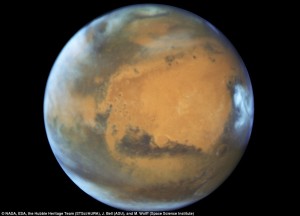
Nasa has revealed this incredible Hubble Space Telescope image of Mars, taken to show off the incredible effect the seasons have on the red planet.
It reveals bright, frosty polar caps, and clouds above a vivid, rust-coloured landscape.
The Hubble Space Telescope view was taken on May 12, 2016, when Mars was 50 million miles from Earth, and reveals details as small as 20 to 30 miles across.
The Hubble Space Telescope view was taken on May 12, 2016, when Mars was 50 million miles from Earth, and reveals details as small as 20 to 30 miles across.
The Hubble Space Telescope view was taken on May 12, 2016, when Mars was 50 million miles from Earth.
The Hubble image reveals details as small as 20 to 30 miles across.
The large, dark region at far right is Syrtis Major Planitia, one of the first features identified on the surface of the planet by seventeenth-century observers.
Christiaan Huygens used this feature to measure the rotation rate of Mars.
About 1,100 miles across and nearly five miles deep, it was formed about 3.5 billion years ago by an asteroid impact.
The orange area in the center of the image is Arabia Terra, a vast upland region in northern Mars that covers about 2,800 miles.
The landscape is densely cratered and heavily eroded, indicating that it could be among the oldest terrains on the planet.
Dried river canyons (too small to be seen here) wind through the region and empty into the large northern lowlands.
South of Arabia Terra, running east to west along the equator, are the long dark features known as Sinus Sabaeus (to the east) and Sinus Meridiani (to the west).
These darker regions are covered by dark bedrock and fine-grained sand deposits ground down from ancient lava flows and other volcanic features.
These sand grains are coarser and less reflective than the fine dust that gives the brighter regions of Mars their ruddy appearance.
Early Mars watchers first mapped these regions.
An extended blanket of clouds can be seen over the southern polar cap.
The icy northern polar cap has receded to a comparatively small size because it is now late summer in the northern hemisphere.
Hubble photographed a wispy afternoon lateral cloud extending for at least 1,000 miles at mid-northern latitudes.
Early morning clouds and haze extend along the western limb.
This hemisphere of Mars contains landing sites for several NASA Mars surface robotic missions, including Viking 1 (1976), Mars Pathfinder (1997), and the still-operating Opportunity Mars rover.
The landing sites of the Spirit and Curiosity Mars rovers are on the other side of the planet.
To see Mars during this rare close approach, look to the sky after the sun sets. Mars will be brightest when it reaches its highest point in the sky, the zone roughly a third of the distance between the horizon and the spot directly overhead. The illustration above shows its position relative to the moon
To see Mars during this rare close approach, look to the sky after the sun sets. Mars will be brightest when it reaches its highest point in the sky, the zone roughly a third of the distance between the horizon and the spot directly overhead. The illustration above shows its position relative to the moon
If you look up at the sky this weekend, you might just be able to catch a glimpse of Mars.
In a rare concurrence of celestial events, stargazers will be able to see the red planet shining brighter than any star or planet in the night sky.
The planet will then reach its closest distance to Earth in more than a decade in the days to follow.
On May 30, Mars will be the closest it has been to Earth in 11 years, at a distance of 46.8 million miles.
Mars is especially photogenic during opposition because it can be seen fully illuminated by the sun as viewed from Earth.
The biennial close approaches between Mars and Earth are not all the same.
Mars’ orbit around the sun is markedly elliptical; the close approaches to Earth can range from 35 million to 63 million miles.
They occur because about every two years Earth’s orbit catches up to Mars’ orbit, aligning the sun, Earth, and Mars in a straight line, so that Mars and the sun are on “opposing” sides of Earth.
This phenomenon is a result of the difference in orbital periods between Earth’s orbit and Mars’ orbit.
While Earth takes the familiar 365 days to travel once around the sun, Mars takes 687 Earth days to make its trip around our star.
This means that it will align with the sun in a way that places Earth directly in between the two objects, Nasa explains.
Starting Sunday night, viewers will be able to see the brightly lit Mars from dusk until dawn.
It will shine 7 times brighter than Saturn, and some 17 times more brilliantly than the red star Antares.
And, red planet will remain exceptionally bright during the weeks to follow.
Once it reaches opposition, it will have quadrupled in brightness just since the start of April, according to EarthSky.
And, it will be 80 times brighter than it is at its faintest point.
This observation was made just a few days before Mars opposition on May 22, when the sun and Mars will be on exact opposite sides of Earth, and when Mars will be at a distance of 47.4 million miles from Earth.
On May 30, Mars will be the closest it has been to Earth in 11 years, at a distance of 46.8 million miles.
Mars is especially photogenic during opposition because it can be seen fully illuminated by the sun as viewed from Earth.
The biennial close approaches between Mars and Earth are not all the same.
Mars’ orbit around the sun is markedly elliptical; the close approaches to Earth can range from 35 million to 63 million miles.
They occur because about every two years Earth’s orbit catches up to Mars’ orbit, aligning the sun, Earth, and Mars in a straight line, so that Mars and the sun are on “opposing” sides of Earth.
This phenomenon is a result of the difference in orbital periods between Earth’s orbit and Mars’ orbit.
While Earth takes the familiar 365 days to travel once around the sun, Mars takes 687 Earth days to make its trip around our star.
As a result, Earth makes almost two full orbits in the time it takes Mars to make just one, resulting in the occurrence of Martian oppositions about every 26 months.