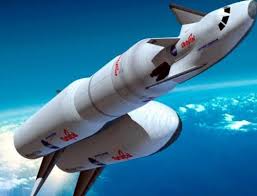
MOSCOW: Russia is building a space taxi to ferry astronauts and interstellar tourists from the International Space Station to the moon in the hopes of building a lunar colony as the first step to a Mars mission.
The private Russian space company Energia announced plans to build the moon taxi, dubbed Ryvok (Charge of Breakthrough), at an international space convention Thursday, according to RT News.

“The cost of the Ryvok reusable manned spacecraft mission is a third lower than the costs of the Federation manned transport spacecraft mission.”
Using reusable rockets that promise to be much cheaper than conventional space ships, Russia would be able to use its moon taxi, permanently docked at the ISS, to transfer astronauts and cargo to the lunar surface using an “accelerator block.”
The journey from the ISS to the moon is expected to take five days and on the return voyage the lunar taxi will use a giant “umbrella” to reduce its speed before it reaches the space station.
The director of the European Space Agency, astronaut Thomas Reiter, is hoping to work with the Russian space agency Roskosmos to build the lunar base, reports RT News.
“We are in the cooperation with Roskosmos on robotic mission, because we think the moon is an excellent destination. It can be a platform for further explorations and indeed moon village will be a very interesting concept.”
The announcement comes as Russian President Vladimir Putin has promised to land the first cosmonaut on the moon by 2029.
Energia, the private Russian space company, plans to use the next generation heavy-lift vehicle the Angara A5, which will replace the old Soyuz rocket, to blast the components of the moon taxi into space.
The idea is that since the moon taxi will live in orbit, it will be cheaper to use because the company won’t have to wait for the Angara to be certified safe for human transportation. Russia hopes the craft will be designed by 2021 with the first launch coming in 2023.
The company hopes the Ryvok will be cheaper than the next-generation Federation spaceship currently under construction that is due to be finished in 2021. The Russian spaceship, which holds four and can spend a year in space, is planned to launch to the ISS in both manned and unmanned modes by 2023.
Russia is hoping to cooperate with the European Space Agency to build a lunar colony as a first step to eventually building a colony on Mars, ISS Program Manager Mark Mulqueen told the Mirror.
“It’s probably the best environment for us to have future life and future subsidence on the planet for the human race to continue.”
The space race is heating up with Elon Musk successfully test landing his robotic reusable rockets and the Chinese aiming to build their own space station in the next 10 years.
China is also working on its own Mars rover and has plans to build a Hubble Telescope lookalike along with a reusable rocket, but for the moment the country is still playing catch up with the U.S. and Russia.
Meanwhile, India successfully launched its own version of a winged space shuttle this month as part of its plan to embark on low-cost space missions, according to the Chron.
“In this flight, critical technologies such as autonomous navigation, guidance and control, reusable thermal protection system and re-entry mission management have been successfully validated.”
In other space news, the inflatable room attached to the ISS, the BEAM, Bigelow Expandable Activity Module, failed to inflate after NASA pumped air into it.