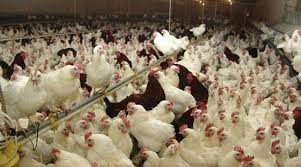
ABUJA: Ghana’s government is currently implementing an ambitious programme aimed at reversing the nation’s dependence on imported poultry by increasing domestic production, writes Francis Ekow de Heer for ThePoultrySite.
The Ghana Broiler Rehabilitation Project (GHABROP), started in 2014, has involved raising tariffs on imported poultry, and requiring poultry importers to source part of their supplies locally. Local producers across the value chain are being assisted to raise production.


But although it is claimed that the local industry has raised production significantly, Ghana is nowhere near the projected target of 60,000 metric tonnes, or 40 per cent of local demand, that was expected to have been achieved by the end of 2016. According to current figures, Ghana will spend $198 million on 170,000 metric tonnes of poultry imports by the close of 2016.
The GHABROP is certainly well intended, but to most industry watchers it has set targets that are perhaps too optimistic.
It is seeking to equip all units in the value chain – hatcheries, farmers, processors, the feed sector and the market – to produce local chicken to drastically reduce the amounts spent on imported chicken.
Under the programme, importers of poultry products are required to source 40 per cent of their products locally. But most poultry farmers are limited by technical and financial constraints, and have been unable to raise production levels.
Mr Napoleon Oduro, Vice president of the National Association of Poultry Farmers, said recently that high production costs had compelled members of his association to raise prices of local chicken, making imported products cheaper.
Some observers believe that Ghana could avoid some painful experiences by taking a look at Nigeria’s poultry situation since the country banned poultry imports in 2003.
The annual domestic demand for poultry is 1.5 million metric tonnes, but Nigeria currently produces 300,000 metric tonnes. The balance of 1.2 million metric tonnes is mostly smuggled into Nigeria across her overland borders.
Maize is the main poultry feed ingredient in West Africa
Local industry players have been calling for financial and other forms of assistance from government to raise domestic production.
The government has carried out seizures of smuggled goods, under Operation Hawk Descend, to discouraged smugglers. But in the current financial crisis arising from the sharp decline in revenues from oil exports, financial assistance will not be forthcoming.
Among other problems, poultry farmers complain about costs of equipment and electricity.
However, the major problem is the high cost of feed. Feed accounts for 60 to 70 per cent of the poultry farmer’s budget, in Ghana and Nigeria.
Maize is the main poultry feed ingredient, but it is a staple feed source of humans in West Africa, and a major industrial raw material. As such it is not only expensive but often scarce.
The other important feed source is soya bean meal, most of which is imported. Experts have often made the point that if poultry production is to become viable in West Africa, it must be based on feed ingredients which are not in competition with humans or industrial uses.
Experts believe that apart from the major problem of feed costs, the Nigerian poultry industry faces other technical problems which may not be solved in the near future.
Among the examples the cite are the unregulated importation of day old and hatchery chicks, the non-regulation of the use of antibiotics and other drugs, and the low standard of biosecurity and sanitary conditions in many commercial establishments. They state that the regulatory and management facilities that should ensure the maintenance of these important standards are simply not there.
Although most Nigerians still believe that the ban on poultry imports must stand, quite a number believe that it is serving no useful purpose, since imported products are flowing into the country anyway. Last October, a heated debate in the House of Representatives on whether to lift or maintain the ban ended inconclusively.
Ghana must learn from the painful fact that 13 years after imposing the ban on imports, Nigeria accounts for only 300,000 metric tonnes of chicken per year.
It must take note of the fact that without solving the problem of feed, the local industry will not be able to raise production to appreciable levels.
Although quite a number of agricultural by-products have been proven to be viable substitutes for conventional feed sources, they are yet to be deployed in commercial production.
Ghanaian researchers have identified cocoa pod husk and palm kernel cake, among several others.Cocoa is a major crop in West Africa, and its waste may be viable in poultry feed
Cocoa pod husk and palm kernel cake are cultivated all over West Africa, and thus provide vast quantities of ready supply. The deployment of cocoa pod husk has been delayed, mainly due to the presence of anti-nutritive factors which preclude inclusion at high levels. But some local research agencies have been involved in the use of bio-technology methods to improve digestibility.
The poultry feed industry is quite small, partly due to the fact that apart from the common practice use of self-compounded feed among many small poultry farmers, most large poultry farmers produce their own feed on-farm, based on conventional feed sources.
Although government officials continually trumpet the nutritional superiority of locally produced chicken compared to imported frozen chicken, consumers are mainly concerned with the issue of price, and would only buy local if the price is ‘right’.