OAKLAND: Following a three-month pilot program to alleviate long truck backups, the Port of Oakland’s largest terminal operator is planning to keep its gates open at night and will begin charging a new flat fee to pay for the extended hours.
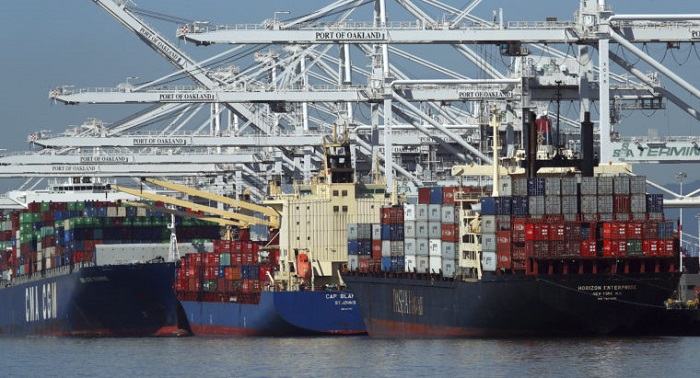
After one of the terminal operators at the port unexpectedly declared bankruptcy earlier this year, other terminals stepped up to absorb more cargo. But with one fewer terminal, truck drivers now have fewer places to pick up or drop off containers. That’s created long lines of trucks queuing on Middle Harbor Road, sometimes backing all the way up to Seventh Street or even to the Interstate Highway 880 off-ramp.

Al Mota, a driver for Ally Trucking Company, Inc., said he often had to wait two or three hours just to get inside the terminal. Once inside, Mota said it could take several more hours before he was able to drop off or pick up a container. A half dozen other drivers shared similar experiences.
Since Mota gets paid per container, the longer it takes him to cycle through the terminal, the less money he makes. “You make good money if the port works with you,” he said. “But, if they don’t, you don’t make any money.”
So, when Ports America closed the Outer Harbor Terminal in March, the port kicked in $1.5 million to help pay for the extended hours at SSA Marine’s Oakland International Container Terminal, which had absorbed 90 percent of Ports America’s cargo. SSA also contributed $1.5 million for the extended hours pilot program, but SSA President Edward DeNike said the company had few other options.
“The volume here is too much to give truckers the service that they want in one shift,” DeNike said. “We just can’t do it, and I don’t think anybody can do it.” And it appears to be working, said John Casem, a driver for Agile Transportation Inc.
“When the other terminal closed, it made traffic worse,” Casem said. “It was bad, but since they’ve had these new hours, it’s lightened up traffic in the morning.” The $30 flat fee, which will go into effect in July, will be assessed on each laden container coming in and out of the terminal. Trucking companies will have to pay that fee, though some may pass it on to customers. DeNike said the terminal would reassess the fee after 90 days to make sure it’s working.
“No one likes fees,” said Chris Lytle, executive director at the Port of Oakland. But labor costs money, and operators pay a premium for stevedores to work at night. “There was no other way to get the job done.” Increasing the port’s ability to move cargo is imperative for the port to remain competitive, said Peter Friedmann, executive director of the Agriculture Transportation Coalition, a national trade group representing agriculture exporters.