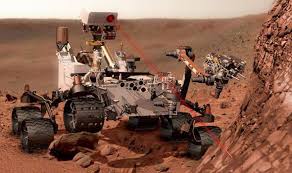
WASHINGTON: Bombarding Martian rock with X-rays, NASA’s Curiosity rover has dug up the first mineral evidence of an explosive type of volcano on Mars that can also be found on Earth.
The findings, described in the Proceedings of the National Academy of Sciences, could hint at the complex dynamics beneath the surface during the Red Planet’s earlier, more dynamic history.
“Maybe Mars is different on the inside than we think it is,” said study lead author Richard V. Morris, a geochemist at NASA’s Johnson Space Center.
Since 2012, Curiosity has been roving Gale Crater, finding evidence of life-friendly environments and a long-lasting series of lakes. In 2014, it finally reached the base of Mt. Sharp, the 3-mile-high mound in the crater’s center whose sedimentary layers of rock can be read by geologists like the pages in a Martian history book.
But one of its stranger discoveries has come years into the mission in a region known as Marias Pass. Exploring this area last year, Curiosity discovered rocks that were surprisingly high in silica, a chemical made of silicon and oxygen.
While there, Curiosity drilled a mudstone named Buckskin and used its CheMin instrument to bombard the powdery sample with X-rays and determine, from the way the X-rays scattered, what the mineral structure was. They found a type of mineral called tridymite, which hadn’t been seen on Mars before.
On Earth, this mineral is formed under high temperatures and low pressures, and typically found in the rocks from explosive volcanoes such as Mt. St. Helens.
That’s really weird, because Mars shouldn’t have that kind of violent activity. Scientists think the Red Planet’s volcanism was of the steady, flowing type, often associated with places like the Hawaiian islands.
“If this is a result of silicic volcanism, which it looks like it is at the moment, something different is going on that we don’t understand yet,” Morris said.
So how did these tridymite minerals form on Mars? For the moment, it’s unclear. The tridymite was discovered in sedimentary rock – which means it probably first formed in volcanic rock, and then fragments of it were transported to their current location and embedded into layers of sediment.
“It had to come from a fairly long ways away, and when things wash down a river into a lake, they get diluted,” Morris said. “So the fact that there’s so much indicates that it’s probably not a special process that forms this.”
Researchers are scratching their heads in part because these rocks on Earth are usually linked to plate tectonics — and the evidence indicates that plate tectonics did not occur on Mars, Morris said.
“Everything we see on Mars doesn’t point toward plate tectonics,” Morris said. “We just need to look really hard for how the high-silica materials can form on Mars, and maybe it’ll turn out there’s some weird low-temperature process we don’t understand. We’ll just have to wait and see on that.”