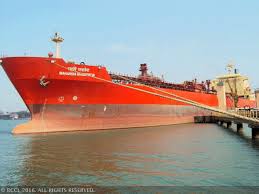
WASHINGTON: Is India’s shipping ministry trying to pass the buck on finding a solution to the stress facing private cargo terminals? The terminals, which started operations at India’s dozen state-owned ports in the initial years of the privatization programme, are under pressure due to policy and rate issues.
The answer to the question lies in a draft bill written by the ministry to transform 11 of the 12 ports, currently run as trusts, into authorities to grant them more autonomy and bring in a professional approach to their governance.

Embedded in the principal objective of modernizing the institutional structure of these ports through a new legislation is a proposal to set up an independent review board. Among other things, the board will be tasked with looking after the residual function of the Tariff Authority for Major Ports (TAMP), the rate regulator for the 11 ports, which will cease to exist once the new law is ratified by Parliament.
The review board will also look into disputes between these ports and public-private partnership (PPP) cargo terminals and complaints regarding services rendered by the ports and PPP terminals. However, the most critical task the review board will be called upon to do is “to review stressed PPP projects and suggest measures to revive such projects”.
It seems the ministry is keen on handing over the controversial task of bailing out stressed terminals or at least make recommendations for a bailout to an agency set up through an act of Parliament. No other infrastructure sector has had such a mechanism to deal with stressed PPP projects that mostly involve lenders and policy corrections. The ministry, in the normal course, would be well within its rights to take a call on that, with the backing of the cabinet. After all, a large part of the problem can be attributed to policy flip-flops after the cargo terminals started operations.
This is what happened in the highways sector where a large number of stressed highway assets were allowed to wriggle out of a tight spot through policy interventions. While new PPP projects could benefit from clear-cut re-negotiation terms written at the time of signing the contract, as announced by finance minister Arun Jaitley in his February budget, re-negotiating existing contracts which haven’t had such provisions could be potentially damaging to the government since it has financial implications.
This could explain why the ministry is trying to legislate on the creation of a review board which would come up with prescriptions for stressed cargo terminals that could be acted upon by the government. In this way, the government could shield itself from charges of giving favourable treatment to cargo terminals at the expense of the exchequer.
The ultimate responsibility of bailing out stressed assets will rest with the cabinet, but the ministry can always turn around and say the recommendation came from an agency set up by Parliament that has members cutting across parties.
While a structural reform of the state-owned ports is expected to usher in an era of market-pricing of services (the panacea for stressed cargo terminals), there are concerns over how the government will manage the rate-setting process for port projects operating since the early days of the PPP regime that has provisions for such a task to be performed by a competent authority written into contracts.
The shipping ministry and private terminal operators have been discussing a potential migration of some 16 existing port contracts (10 of them private)—some operating from as far back as 1997—from a regulated set-up to a market-driven pricing regime. On average, the 16 existing contracts covered by a tariff guideline framed in 2005 have about 11 years or more to end their term of 30 years. Such a freedom to the PPP operator to set rates under a new law can be construed as a change in the initial bidding terms leading to financial benefit to the private firm, consulting firm Deloitte Touche Tohmatsu India Pvt. Ltd, wrote in a shipping mandated study submitted in 2014.
To tackle this, Deloitte has suggested that the most suitable option for the government would be to go for re-bidding of the projects for the market to determine a suitable revenue share that can be expected from the respective projects in a deregulated scenario. Port contracts at state-owned ports are decided on the basis of revenue share; the entity willing to share the most from its revenue wins the deal, typically spanning 30 years. However, none of the private cargo terminals that are facing distress are willing to undergo re-bidding, fearing that they could end up paying a higher revenue share because of the pricing freedom.
Private cargo-handlers say they are bound by statutory changes in the governance structure of major ports and a consequent shift to a market–based pricing regime. “In such an event, the law over rides the contract,” the chief executive of a private terminal operating at Chennai port said, stressing that re-bidding was not an option for PPP terminal operators. The proposed independent review board would chart ways to fix the issues that have roiled private investors.