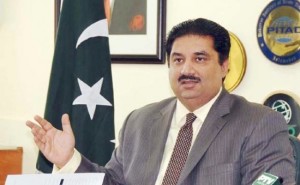
ISLAMABAD: Federal Commerce Minister Khurram Dastgir Khan has said that the size of e-commerce in Pakistan would be expanded to $1 billion by 2020.
“The government has already tasked a committee of ministers to formulate a national policy on e-commerce,” he informed a round-table on ‘E-Commerce for Development’ at the 14th meeting of United Nations Conference on Trade and Development (Unctad) in Nairobi, Kenya.


He was one of the three speakers from developing countries. The Unctad e-commerce readiness index for the developed world is 77 and for developing Asia it is 41. While Pakistan’s index stands at 36, it is marginally higher than the Saarc average.
According to a commerce ministry press release, Dastgir said this lower index shows that there is a huge task ahead of the e-trade initiative in Pakistan and so the government is working at an accelerated pace to boost online trade.
“Our broadband penetration rate has doubled every single year since 2013 and the Global Findex report shows that we lead mobile banking transactions in South Asia with 11pc of our citizens using mobile phones to carry out financial transactions,” the minister said.
“Pakistan is working hard to update the rules and regulations governing digital trade and has ratified the trade facilitation agreement (TFA). We have electronic transaction laws and have recently passed cyber crime laws, while data and consumer protection laws are in pending”, the minister said.
An official statement said that consumer protection is essential to fully employ e-commerce.
The minister spoke of the bright future of e-commerce in Pakistan pointing out its well equipped financial and telecom sectors. “We welcome technical assistance to incorporate the whole ecology needed for e-commerce, particularly a regulatory framework, payment platforms, dispute settlement mechanisms and consumer protection laws”, the minister said.
The initiative will help developing countries in seven areas, including e-commerce assessment, information and communication technology infrastructure, payments, trade logistics, legal and regulatory frameworks, skill development and financing for e-commerce.