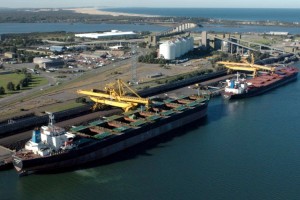
CANBERRA: The Newcastle Coal Export Terminal is understood to be the next major target of advisers in the restructuring space, with the owners said to be preparing to refinance loans worth about $3.5 billion. It comes after lenders to the Wiggins Island Coal Export Terminal in Queensland appointed insolvency firm McGrath Nicol to represent their interests. The shippers that own that facility are wrestling with the $US3 billion ($4.1bn) of loans owing amid challenging conditions in the coal industry. The WICET shippers, which include Glencore and Wesfarmers, are taking advice from Fort Street Advisers. Liabilities for both the owners of the WICET and the Newcastle facilities are said to be owed to most of Australia’s top banks as well as offshore lenders within the syndicate.
The parties are confronting the reality of hefty repayments at a time when demand for coal exports is weak, which is placing pressure on the operations to generate the earnings needed to meet the interest payments. The Newcastle coal export terminal is owned by the Newcastle Coal Infrastructure Group. The project was done more than six years ago in buoyant conditions. However, the NCIG said earlier this year that it continued to see strong throughput volumes against a backdrop of a difficult coal market environment involving low coal prices and high uncertainty. Chief executive Aaron Johansen said at the time that 2015 was the fifth straight record year, with a throughput in excess of 49 million tonnes.


The Terminal is located on Kooragang Island at the Port of Newcastle in NSW, about 160km from Sydney. It services long-life coalmines in the Newcastle, Hunter Valley, Gunnedah, Gloucester and western coalfields of NSW by providing access to port infrastructure to export production. It has been operating since 2013, with most of the throughput thermal coal.
Owners of the NCIG, which was formed in 2004, include Banpu, BHP Billiton, Peabody Energy, Whitehaven Coal and Yanzhou Coal. It operates in a similar way to WICET with take-or-pay contracts, where the shippers are required to make payments to the lenders regardless of the coal volumes that are exported through the terminal. It will be interesting to see how Peabody Energy navigates the payments, given it remains in Chapter 11 bankruptcy in the US, where it is headquartered.
Meanwhile, investment banks were gearing up for a prospective role on Alinta Energy on Friday, with further suggestions in the market that the private equity owner TPG Capital will now try to float the business on the Australian Securities Exchange after key bidder China Huadian withdrew from the Lazard-run contest. Plans for a float may offer some competitive tension for AGL Energy, a suitor for its more valuable West Australian retail energy assets, which are said to be worth about a third of the entire $3bn-plus operation.
Such a move may also put pressure on AGL, advised by Citi, to find buyers of the remaining part of the business, to ensure it can secure the retail arm and the rest does not instead get listed. If Alinta heads to the bourse, it will be the second deal for which TPG will be relying on equity investors for hefty profits. Already, some are predicting that its float of Inghams Enterprises will reap the buyout shop proceeds of about $2bn.