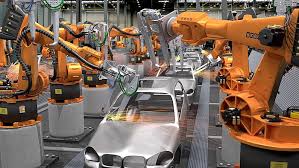
BERLIN: A Chinese factory near Shanghai is relying on a new breed of workers to maintain its competitive advantage in assembling electronics devices: small robots designed in Germany.
Suzhou Victory Precision Manufacture chairman Yugen Gao said the days when the company drew its strength from China’s cheap and hardworking employees were gone.

“We’ve been losing that edge in the past three years,” Mr Gao said in his office, overlooking buildings where a battalion of robots was cranking out computer keyboards. “It’s one of the effects of the one-child policy.” China’s appetite for European-made industrial robots is rapidly growing as rising wages, a shrinking workforce and cultural changes drive more Chinese businesses to automation.
The types of robots favoured by Chinese manufacturers also are changing as automation spreads from heavy industries such as car manufacturing to those that require more precise, flexible robots capable of handling and assembling smaller products, including consumer electronics and apparel. At stake is whether China can retain its dominance in manufacturing.
“China is saying, ‘We have to roboticise our industry in order to keep it’,” said Stefan Lampa, chairman of the robotics division of Kuka, a German automation firm and a supplier to Suzhou Victory.
The rush to buy robots comes in part because China’s population of workers aged 15 to 59 is starting to shrink, forcing manufacturers to turn to automation. The UN estimates the number of the country’s workers peaked in 2010 at more than 900 million and will fall below 800 million by 2050.
In addition, the average hourly labour cost defined as wages plus benefits — of $US14.60 ($19.05) in China’s manufacturing heartland has more than doubled as a percentage of US manufacturing wages, from roughly 30 per cent in 2000 to 64 per cent last year, according to Boston Consulting Group, making China less competitive for manufacturers.
In 2013, China became the largest market for industrial robots, surpassing western Europe, according to the International Federation of Robotics. Last year, Chinese manufacturers bought roughly 67,000 robots, about a quarter of global sales, and demand is projected to more than double to 150,000 robots annually by 2018.
Chinese firms also are investing in industrial technology, with an eye towards building more of their own robots. Chinese home-appliance maker Midea Group Co launched a bid to buy Kuka for more than $US5 billion in May and now owns about 86 per cent of the company. Some German politicians criticised the deal, saying Kuka was a strategic asset that should have remained German or European-owned.
At a robotics-research conference in Stockholm in May, companies including Kuka and Switzerland’s ABB displayed lightweight robots with agile arms capable of manipulating items as small as bottle caps.
Last year, ABB introduced a two-armed version of its YuMi, a lightweight robot designed for the Chinese market. It can put together car-dashboard electronics, wristwatches and eyewear. YuMi, which is manufactured in Sweden and in a sister factory in Shanghai, was designed as a “collaborative” robot, meaning it is safe enough that it can share the manufacturing line with humans and doesn’t require a protective cage, as many large industrial robots do.