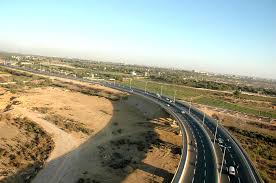
KARACHI: To provide respite to the metropolis’ commuters, the Sindh government with the Asian Development Bank’s funding announced construction of the Malir Expressway in the South of the city, to divert all heavy traffic plying to and from the port and industrial areas.
Starting from the Karachi port and stretching up to the Super Highway, the expressway would be built with finances agreed to be provided by the Asian Development Bank (ADB); the decision to this effect was taken at a meeting held at the Chief Minister House on Thursday. Sindh Chief Minister, Syed Murad Ali Shah, and ADB’s country director Werner E Liepach discussed the projects in assistance with their respective teams; Additional Chief Secretary (Dev) Mohammad Waseem and principal secretary to CM, Naveed Kamran Baloch were also in attendance.


The expressway would start from the Karachi port and pass through the Defence, Korangi roads which run parallel to the Malir river, the road would further go up to the Korangi Industrial Area, National Highway to the Link Road and end at the Super Highway. The CM stated the ADB was already facilitating the federal government in constructing the Harbour Front Bridge which would connect to the Lyari Expressway. He added that when both the projects would be completed the city would have two ring roads towards which the entire heavy traffic could be diverted.
The ADB country director said the project was workable and that some of its papers were shared with him and his team. He urged CM Murad to expedite the paper work and survey in order for the ADB’s board to approve the funding in its meeting scheduled for October.
ACS (Dev) Mohammad Waseem briefed the meeting on Rs62 million ADB funded projects, which included Rs19 million allocated for Sindh Cities Improvement Programme, Rs23million for the Sindh Provincial Road Improvement Project and Rs20 million for Enhancing Public Private Partnership in Sindh.
Sindh Cities Improvement Programme was aimed at increasing quality, reliability and coverage of water and waste management services in towns included in the project. Service delivery, operational outreach or coverage in marked areas, delay in awarding as well as executing contracts, old drainage system, low voltage and load shedding, lack of civic sense, unplanned urbanisation and lack of infrastructure and staff were highlighted to be some of the issues that the teams had had to face so far.
The ADB was of the view that local bodies of concerned towns should recover water supply and garbage lifting charges, the tariff for which could be subsidised by them; recoveries of service charges was necessary to be developed in order for the citizens to develop a sense of responsibility.
The chief minister proposed the ADB to start from two cities of its own choice as model cities and then go on to expand the projects. The issue was decided to be further discussed between ADB representative in Karachi and ACS (Dev) Waseem. This project was started in 2008 and would be completed in 2018.
Under the Sindh Roads Improvement Project, six roads stretching over 328 kilometres were being constructed. Under the project city to city road network would be enhance which would consequently have a good effect on socio-economic activities.
Improved road connectivity would save travel time, as well as save vehicles from such intense wear and tear. The roads being reconstructed included Tando Mohammad Khan, Badin, Matiari, Mirpuurkhas, Sanghar, Jacobabad, Kandhkot-Kashmore and Larkana. The ADB had earmarked Rs2 billion for the current financial year while the Sindh government had already allocated Rs200 million.