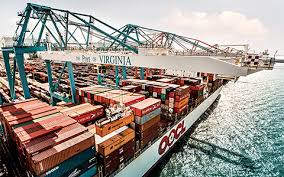
WASHINGTON: The Port of Virginia aims to grab US containerized market share by attracting more Midwest shippers to its intermodal rail connections while also improving its road and terminal gate fluidity to keep existing local and regional shippers happy after rashes of congestion.
The improvements, in terms of both infrastructure and better usage of terminal truck time data, comes as Virginia tries to become an even larger feeder of cargo to the Chicago market and surrounding Midwest. Stronger intermodal rail connections and smoother truck flows are crucial as the port sees larger ships call its docks thanks to the expanded Panama Canal, which can now handle ships up to 14,000 twenty-foot-equivalent units. Meanwhile, a burgeoning barge service is relieving capacity pressure at terminals on the Virginia waterfront and providing a service for niche shippers of overweight goods.

“The ships have already gotten larger. The discharge and load is getting larger, so what you need to do is make sure you are using every conveyance to get cargo out of the port. We need rail, we need water, we need road,” John Reinhart, port authority director and CEO, told JOC.com. Reinhart’s approach has led to what some have called a turning point for the Port of Virginia, which was facing a mountain of challenges — working at both an operating profit and volume loss for months on end — just more than a year ago.
Virginia’s market share of the overall US containerized trade was 6.02 percent from January to July of this year, according to data from PIERS, a sister product of JOC.com within IHS Markit. According to that same data, the port handled 5.21 percent of all US imports and 7.4 percent of all US exports in that time. The port’s East Coast market share for both imports and exports in the first seven months of 2016 was flat compared to 2015. Taken individually, import market share rose four-tenths of a percentage point year-over-year as export market share slipped five-tenths of a percentage point, according to PIERS.