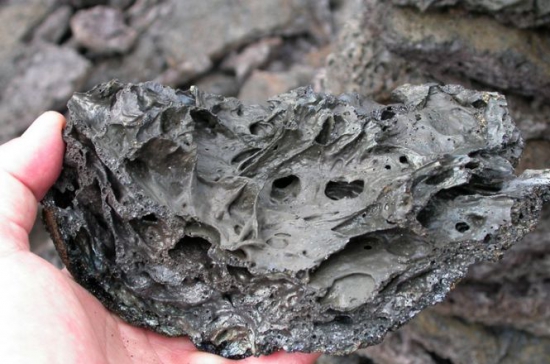


NEW YORK: Researcher’s verification of natural activity inside a meteorite from Mars that landed on the Moroccan desert in 2011. According to a new study via an international Tissint meteorite team of scientists published in December 1, 2014 issue of the journal Meteoritics and planetary sciences, a Martian rock Tissint meteorite which landed on Earth in July 2011, may contain evidence of early life on Mars.
Philippe Gillet, director of Ecole Polytechnique de Lausanne (EPFL, Switzerland) Earth and Planetary Sciences Laboratory and colleagues from China, Japan and Germany performed a detailed analysis of organic carbon traces from a Martian meteorite, and have concluded that they have a very probable biological origin. The scientists argue that carbon could have been deposited into the fissures of the rock when it was still on Mars by the infiltration of fluid that was rich in organic matter.
Ejected from Mars after an asteroid crashed on its surface, the meteorite, named Tissint, fell on the Moroccan desert on July 18, 2011, in view of several eyewitnesses. Upon examination, the alien rock was found to have small fissures that were filled with carbon-containing matter that is organic in nature. But where did the carbon came from?
Chemical, microscopic and isotope analysis of the carbon material led the researchers to excluded a terrestrial origin, and suggested that the carbon content were deposited in the Tissint’s fissures before it left Mars.
According to the new study, a likely explanation is that liquids containing organic compounds of biological origin infiltrated Tissint’s “mother” rock at low temperatures, near the Martian surface.
These conclusions are supported by several intrinsic properties of the meteorite’s carbon, e.g. its ratio of carbon-13 to carbon-12. This was found to be significantly lower than the ratio of carbon-13 in the CO2 of Mars’s atmosphere, previously measured by the Phoenix and Curiosity rovers.
Moreover, the difference between these ratios corresponds perfectly with what is observed on Earth between a piece of coal – which is biological in origin – and the carbon in the atmosphere. The researchers note that this organic matter could also have been brought to Mars when very primitive meteorites – carbonated chondrites – fell on it. However, they consider this scenario unlikely because such meteorites contain very low concentrations of organic matter. Gillet said:
Insisting on certainty is unwise, particularly on such a sensitive topic. I’m completely open to the possibility that other studies might contradict our findings. However, our conclusions are such that they will rekindle the debate as to the possible existence of biological activity on Mars – at least in the past.

Karachi Port sets 138-year cargo handling record
KARACHI: Pakistan's maritime sector has achieved a major milestone as Karachi Port set a new record in its 138-year history...