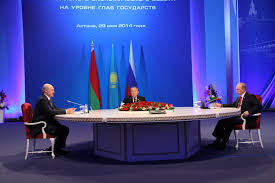
BISHKEK: Heads of the Eurasian Economic Union member states signed the EEU Customs Code at the summit of the Supreme Eurasian Economic Council on December 26 in St. Petersburg. The new Customs Code will enter into force from July 1, 2017.
Kazakhstan ends its chairmanship in the EEU this year and Kyrgyzstan will take it over in 2017. The EEU also includes Armenia, Belarus, and Russia.


The EEU Customs Code creates entirely new conditions for business, greatly simplifying customs procedures, Kazakh President Nursultan Nazarbayev said at the summit.
“Despite difficult external economic environment, through our joint efforts we have managed to move forward in the implementation of the main priorities proposed by Kazakhstan at the beginning of the year,” Nazarbayev said. An electricity market development program has been completed, and creation of a common financial market has begun.
The year 2016 is significant for Kyrgyzstan as a full EEU member, President of Kyrgyzstan Almazbek Atambayev said at the beginning of the summit. There have been many changes, both positive and negative, and “sometimes negative prevailed,” and this was bad for the country’s integration into the EEU, he added.
Following the meeting, Chairman of the Eurasian Economic Commission Tigran Sargsyan said that Kyrgyzstan had not signed the Customs Code but later he said that the document had been approved by Bishkek.
According to Russian President’s press secretary Dmitry Peskov, Kyrgyzstan and Belarus did not fully agree with the Customs Code. There were some comments from the Kyrgyz side, and they were mainly related to the pest control. “The EEU Customs Code is viable, and there is no alternative to it. There is no doubt that sooner or later it will enter into force for future integration processes,” Peskov told the media.
The work on the Customs Code will continue at the level of heads of government of the EEU member states. Belarus would also approve the document, because that country previously agreed with the Code’s provisions, Peskov added.
Later this week, Kyrgyz Deputy Prime Minister Oleg Pankratov told journalists why there was a hitch with the signing of the Customs Code. There was a need to clarify whether the last notes of Kyrgyzstan had been considered. Once the issue was clarified, the President signed the document. There were no other reasons, only technical aspects, he concluded.
Kyrgyzstan was the only country to discuss this issue, because in addition to general EEU documents there is a separate agreement on Kyrgyzstan’s accession to the EEU which provides certain benefits for Kyrgyzstan in the transitional period. It was therefore important that the Code and the treaty did not contradict each other, Pankratov explained.
Kazakhstan will allocate $100 million to Kyrgyzstan as technical assistance within the EEU. The relevant agreement was signed in St. Petersburg.
The money will be spent for the improvement of Kyrgyz customs checkpoints and equipping laboratories according to the EEU standards.
At the summit, Kyrgyzstan and Kazakhstan also signed an agreement on the transition to unified railway tariffs. This means that from the second decade of January entrepreneurs of Kyrgyzstan who carry goods by railway from Russia to Kyrgyzstan through Kazakhstan will pay much less. As a result, the cost of strategic goods (fuel, wood and metal) will reduce in Kyrgyzstan.
Before ratifying the EEU Customs Code, it is necessary to study it carefully, Kyrgyz MPs said on December 29.
Kyrgyzstan depends on imports, so it is vital to carefully consider how the Code would affect local entrepreneurs who cooperate with non-EEU countries, as China and Turkey, the MPs said.
Kyrgyz public figure Edil Baisalov believes that the Parliament should not ratify the Customs Code and the country should withdraw from the EEU. “If we are really experiencing the negative effects of this Union and are imposed laws against our will (what could be more important for the sovereignty than the customs regulations?), then there is a very simple question: why do we continue to stay in the EEU?” Baisalov wrote on his social-media page.
President of Belarus Alexander Lukashenko did not attend the summit. Belarusian authorities have criticized the EEU provisions in recent months, saying that it has become a political project, and the basic rules for the creation of a common market were often violated, Baisalov said. Kyrgyzstan’s neighbors Tajikistan and Uzbekistan, and most importantly China, the major trading partner, are not members of the EEU.
Earlier, Baisalov was the leader of the Coalition for Democracy and Civil Society, chief of staff of the interim government in 2010, and acting Social Development Minister in 2012.
Kyrgyzstan’s trade with the EEU countries decreased in the first 10 months of 2016 by 18.6%, the National Statistical Committee of Kyrgyzstan said. At the same time, the country continues to increase bilateral trade with China, Uzbekistan, the United States and Great Britain.
Trade between Kyrgyzstan and its major trading partner China reached $1.289 billion (1.5-fold increase compared to the same period of 2015). Exports to China were insignificant – $48 million while imports reached $1.241 billion (1.5-fold increase). China’s share in Kyrgyzstan’s total trade was 29.3% in the first ten months of 2016.
Russia is the second largest trading partner of Kyrgyzstan with a trade turnover worth $878.9 million (-27.3% compared to 2015). The share of Russia in Kyrgyzstan’s total trade was 20% compared to 26.1% in January-October 2015.
Kazakhstan is the third largest trading partner of Kyrgyzstan with 15.1% share in the total trade turnover.
China continues to increase its economic presence in EEU countries. Since 2008, foreign direct investments (FDI) of Chinese companies in the five EEU countries have increased by 138% and reached $25.7 billion, the Center for Integration Studies of the Eurasian Development Bank said.
Belarus and Kyrgyzstan are leaders among the EEU member countries in terms of attracting FDI from China, with 48% and 19% growth respectively.
In absolute figures, Kazakhstan is the main recipient of Chinese FDI ($21 billion) in the EEU. The country’s oil and gas production and transportation have received most Chinese investments in the country.