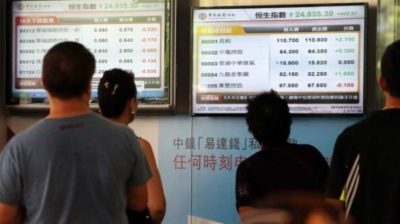
BEIJING: Chinese stocks fell for the first time in four days, as home appliances makers dipped after a major shareholder sold a stake in industry giant Midea Group, and other industrial companies retreated. The Shanghai Composite Index slid 0.3 per cent, 10.49 points, to 3,079.74 at the midday break. The CSI 300 Index lost 0.1 per cent, or 2.54 points, to 1,830.64. In Hong Kong, major stock gauges also sank, on concern recent gains were excessive. “The mainland’s market sentiment is still pretty weak and any negative news would trigger a sell-off in a stock or a sector,” said Wei Wei, a trader at Huaxi Securities. “For Hong Kong, the market is still in an upward trend but it will suffer from profit taking from time to time before setting a new high.” In Hong Kong, the Hang Seng Index dropped 0.3 per cent, or 63.3 points, to 25,308.29 by the noon break, falling from its highest close since July 2015. The Hang Seng China Enterprises Index of Chinese companies trading in the city slid 0.6 per cent, or 61.1 points, to 10,389.25. The 14-day relative strength index for the Hang Seng gauge rose to 73 on Monday, above the 70 threshold, suggesting stocks may fall, because of being overbought, said analysts. The weakness in the mainland and Hong Kong markets bucked the overnight strength of US stocks, as the US’s two major indexes hit record levels. Hong Kong stocks have been so far immune to Chinese policy makers’ ongoing crackdown against financial leverage.
The Hang Seng Index has gained 15 per cent so far this year, compared with a 0.8 per cent decline on the Shanghai Composite. Even though, stocks in the former British colony are still 16 per cent cheaper than mainland equities, according to a measure tracking the price difference between the two markets. Midea, China’s biggest maker of home appliances, lost 0.8 per cent to 35.04 yuan (US$4.75) after exchange data showed the company’s actual controller He Xiangjian has sold 32.3 million shares in a block trade through the secondary market on Friday. The decline pared the stock’s gain to 29 per cent this year. Midea, China’s biggest maker of home appliances, lost 0.8 per cent to 35.04 yuan (US$4.75) after exchange data showed the company’s actual controller He Xiangjian has sold 32.3 million shares in a block trade. Hangzhou Robam Appliances fell 1.3 per cent to 41.58 yuan and Shanghai Flyco Electric Appliance retreated 0.9 per cent to 51.53. Xinjiang Tianshan Cement led the mainland’s industrial stocks lower as investors offloaded stocks following the conclusion of the two-day “Belt and Road Initiative” summit in Beijing. The stock tumbled 4.5 per cent to 13.62 yuan, trimming its gain to 93 per cent this year. On the contrary, investors bought consumer stocks on optimism their earnings will better weather from the financial cleanup. Liquor giant Kweichow Moutai rose 2.4 per cent to 429.47 yuan, on course for a record close. Wuliangye Yibin gained 4 per cent to 47 yuan.
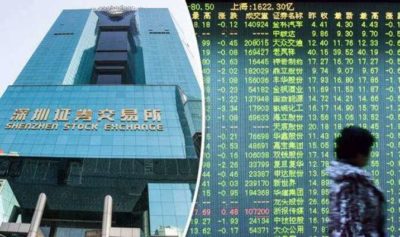

In Hong Kong, financial companies were the biggest decliners on Tuesday. Postal Savings Bank of China slumped 5.6 per cent to HK$4.69, while China Huarong Asset Management dropped 1.9 per cent to HK$3.16. The S&P 500 Index and the Nasdaq Composite Index both added 0.5 per cent to records on Monday, and the Dow Jones Industrial Average advanced 0.4 per cent. Crude oil futures climbed more than 2 per cent after Saudi Arabia and Russia favoured extending a production-cut deal for longer-than-expected, by another nine months. Early morning stock trading in Asia was mixed, as Japan’s Nikkei 225 added 0.2 per cent and South Korea’s Kospi rose 0.1 per cent.