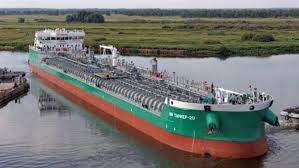
TEHRAN: Iran’s northern port of Neka received two batches of Turkmen oil this month, prompting speculation that Tehran may be resuming oil swaps with its Caspian Sea neighbours after a five-year hiatus. On August 9, Azerbaijan’s Trend News Agency quoted a market source as saying that an oil tanker owned by Russian shipping group VF Tanker had arrived in the Azeri port of Baku laden with 6,000 tonnes (44,000 barrels) of Turkmen oil. The crude had been produced by Dragon Oil, the operator of the Cheleken block in the Turkmen section of the Caspian. According to the source, the tanker was unable to offload at Baku, however, after some undeclared cargo was identified on board. The vessel, known as VF Tanker-20, then headed south, depositing its cargo at the Neka oil terminal on August 3.
On August 7, the source said the vessel had embarked on a fresh voyage from the Turkmen port of Alaja, once again carrying crude supplied by Dragon Oil. Initially it had followed a course to Baku, but after exiting Turkmen waters, immediately bore south again towards Neka. The source noted that this manoeuvre had been necessary because Dragon Oil likely did not have permission from Turkmen authorities to export its crude to Iran. National Iranian Oil Co. (NIOC), the owner of the Neka terminal, confirmed receiving two Turkmen oil shipments in a statement on August 13. The NOC noted that Dragon Oil was currently loading a third cargo of oil onto another vessel owned by VF Tanker, but did not specify whether this cargo would also be despatched to Iran.


Observers have speculated whether the recent shipments may indicate a return to Iranian oil swaps in the Caspian. Tehran struck its first swap deal in 1996, receiving its first test delivery of Kazakh crude the following year. It subsequently began trading oil with Russia and Turkmenistan, taking supplies at Neka and then exporting equivalent amounts of its own production on the former two states’ behalf, mostly via its Kharg Island terminal in the Persian Gulf. The popularity of these swaps began to wane and halted completely in 2012, however, amid pricing disputes between Iran and its partners as well as the introduction of further US sanctions on Tehran. For its part, Dragon Oil halted deliveries two years earlier, in 2010, promptly redirecting volumes to ports in Russia and Azerbaijan for delivery onwards to Europe. There are several reasons to doubt that the recent shipments will lead to oil swaps between Iran and Turkmenistan on a regular basis.
First, the Russian tanker’s indirect route to Neka suggests that a formal agreement between Iran and Turkmenistan on oil swaps is not in place. Indeed, the two littoral states are currently embroiled in a feud over gas prices and historic debts, making such a deal unlikely at this juncture. Meanwhile, Dragon Oil may want to avoid exposing itself to the risks of expanded trade with Iran. Companies have generally been reluctant to resume business with the Islamic Republic for fear of US penalties. Following the 2015 Iran nuclear accord, Washington began dismantling its sanctions regime against Tehran, although with US President Donald Trump having threatened to scrap the deal, there is a risk that the punitive measures could be reapplied.
Dragon Oil, which carries out all its transactions in US dollars and which works with US contractors and has US citizens occupying some of its top managerial positions, would be particularly vulnerable to a change in US policy. What is more, the producer’s parent company is Emirate National Oil Co. (ENOC), the state oil company of the United Arab Emirates, one of Washington’s closest allies in the Middle East. In recent years, Iran has called for its Caspian Sea neighbours to resume oil swaps, although there is no evidence that Tehran has managed to strike deals with any producers in the region. Even at their height, the swaps were never as popular as Iran would have liked, with volumes remaining under 100,000 bpd despite claims by Iranian officials that shipments could rise to 300,000 bpd and even as much as 1 million bpd once Iran’s import capacity had been expanded. Other states were less enthusiastic about the swaps, questioning whether they were more cost-effective than regular overland pipeline transport.