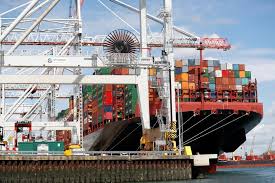
LONDON: At Southampton docks, a top British port for trade with countries outside the EU, the scene is one of frictionless international commerce. It’s a model that business leaders hope will also work well with Europe after Brexit, but fear it won’t. Cranes lift containers smoothly on and off enormous ships berthed at the quayside while rows of new cars await shipment to destinations including the United States and Asia. There is little sign of the customs border that Britain maintains with most of the world apart from European Union states, thanks to a long-refined system of goods declarations completed electronically as ships plough to and from the country. Less than two percent of goods passing through Southampton, which lies on the south coast of England, are subject to physical checks by customs officials, according to its owner, Associated British Ports.
At the moment Britain has no such customs border with the EU, a free-trade area of 28 states, but it is likely to reimpose one when it leaves the bloc in March, 2019. If London and Brussels fail to strike a trade deal, each side will start imposing import duties on each other’s goods. Few people believe the current system for non-EU trade can be replicated for EU goods without disruption at the seaports through which 95 percent of Britain’s international trade moves. That means industry’s wish for minimal extra red-tape, delays and costs after Brexit may not be granted. The government estimates a new, upgraded electronic customs system – due to be introduced just two months before Brexit – will need to process 255 million customs declarations a year, up from 55 million now. “Is a new IT system going to be able to cope with a sudden massive surge in stuff going through? … It is a highly complex environment and the capacity for glitches is bound to be there,” said Guy Platten, Chief Executive of the UK Chamber of Shipping.


The EU is Britain’s largest trading partner, accounting for 44 percent of exports and 53 percent of imports in 2016. Around 180,000 companies which now operate only within the EU face making customs declarations for the first time after Brexit. A study by the Institute for Government found that those declarations could mean a total additional cost of 4 billion to 9 billion pounds ($5 billion to $12 billion). “Costs will be passed on and it is going to impact on the consumer and on prices in the shops in the end,” Platten told Reuters. The government has proposed two options for a post-Brexit customs deal with the EU: a “highly streamlined” system using technology to create as frictionless a border as possible, and a new customs partnership removing the need for a customs border – an arrangement that would be particularly hard to negotiate. The first would involve measures such as pre-arrival notifications linked to customs declarations and vehicle registrations so trucks do not have to stop at the border, as well as pre-approved “authorised economic operators” who are given faster clearance.