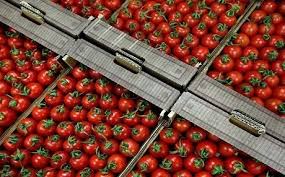
ISTANBUL: Over two years have passed since Turkey shot down a Russian jet in November 2015. The event triggered a major crisis as Moscow responded with a string of economic sanctions. Since President Recep Tayyip Erdogan’s apology in June 2016, the relationship between Turkey and Russia has notably improved: Russian tourists are returning to Turkish resorts, visa requirements for Turkish businesspeople have been lifted and bilateral trade is on the rise.
Among the restrictions that Russia imposed on fruits and vegetables from Turkey, the ban on tomatoes lasted the longest, with the tomato becoming a symbol of the crisis. Even after frequent bilateral meetings, Erdogan and President Vladimir Putin still could not agree on the tomato issue. Russian officials argued that the ban remained in place to encourage domestic producers, although Turkish tomatoes reportedly continued to make their way to Russia indirectly, via third countries.


Yet, ahead of the second anniversary of the plane crisis, Moscow finally lifted the tomato ban. On Nov. 10, a company in the Aegean province of Izmir exported its first shipment of tomatoes to Russia under a contract for 5,000 tons. The resumption of the tomato trade was greeted with joy in Turkey as a sign that the crisis was over. The Turkish producer who dispatched the first shipment put the price at $1.50 per kilogram (68 US cents a pound). The producer said that last year, when Turkish tomatoes were banned from the Russian markets, tomato prices had even reached $30 per kilogram in Russia.
However, while Russian consumers may now enjoy cheaper tomatoes, tomato prices for Turkish consumers are on the rise.
In October, the price per kilogram of tomatoes fluctuated between 3-4 Turkish liras (80 US cents to $1.04 a kilo, or 36 to 47 cents a pound). Following the resumption of tomato exports to Russia in November, the price per kilogram in Turkey rose to 5-6 liras. Prices rose again the first week of December — up to 6-8 liras a kilo — due to the winter season and an increase in production costs. Al-Monitor asked several grocers why tomatoes had become so expensive. They all pointed to the resumption of exports to Russia, saying their own buying prices had increased.
The price hikes have already impacted consumer inflation; prices soared a staggering 1.49% from October to November, pushing annual inflation to 13%. Tomato prices played a key role in the increase, rising 45.3% in only a month.
So, what is next? At this rate, the price of tomatoes could rise to 10 liras in the coming days. When food prices shoot up, Ankara’s usual response is to resort to imports. To rein in skyrocketing meat prices, for instance, the government greenlighted the import of cheaper meat to discipline local producers and middlemen.
Importation is currently on the table for haricot beans and chickpeas as well. According to the Union of Turkish Chambers of Agriculture, the consumer prices of haricot beans and chickpeas increased 6.08% and 7.1%, respectively, from October to November. In early December, the government stepped in, reducing customs duties to zero on haricot beans, chickpeas and cranberry beans, thus opening the door to importation.
Using the import weapon is becoming a knee-jerk reaction to battle food inflation in Turkey. Yet the way to combat food inflation is to increase production of food. Importation may seem like the fastest and most efficient way to rein in prices, but the improvement is usually short-lived, followed by a lasting blight on local agriculture. This, in fact, reflects the failure of Ankara’s agriculture and husbandry policies.
A continuing increase in tomato prices may eventually lead the government to consider importing tomatoes as well. According to an agriculture report by the main opposition Republican People’s Party, Turkey has imported tomatoes from Turkish Cyprus, Romania and Ukraine in previous years. Yet the current increase in prices stems not from shortcomings in production or excessive exports, but speculative moves on the market.
Russia plans to buy 50,000 tons of tomatoes from Turkey per year. In 2016, Turkey’s tomato production stood at 12.6 million tons per year, meaning that the scale of exports to Russia can hardly upset the general production-consumption balance at home. The abrupt price hikes, following an export contract for 5,000 tons, suggest that producers and middlemen are exploiting the Russian pretext.
Moreover, Turkish consumers are aggrieved not only in terms of prices but quality. Due to tight Russian control, low-quality tomatoes cannot make their way to Russia. The domestic market, however, lacks a quality control mechanism. With the arrival of fall, Turkish consumers are usually offered hollow, tasteless tomatoes that often look hormone-injected.
The tomato trade aside, Turkish-Russian commercial ties have also begun to improve, though slowly. According to figures from the Turkish Ministry of Economy, exports to Russia stood at $2.1 billion in the first 10 months of 2017, up from $1.3 billion in the same period last year, when the fallout from the jet crisis was most tangible. Similarly, imports from Russia amounted to $15.7 billion in the period between January and October, up from $12.5 billion in the same period last year. In terms of the total trade volume between the two countries, the figure increased from $4 billion to $17.8 billion.
Yet the trade volume in 2014 and 2015 stood at $31.2 billion and almost $24 billion, respectively, meaning that, despite the impressive political rapprochement, there is still a long way to go before pre-crisis levels of trade resume.