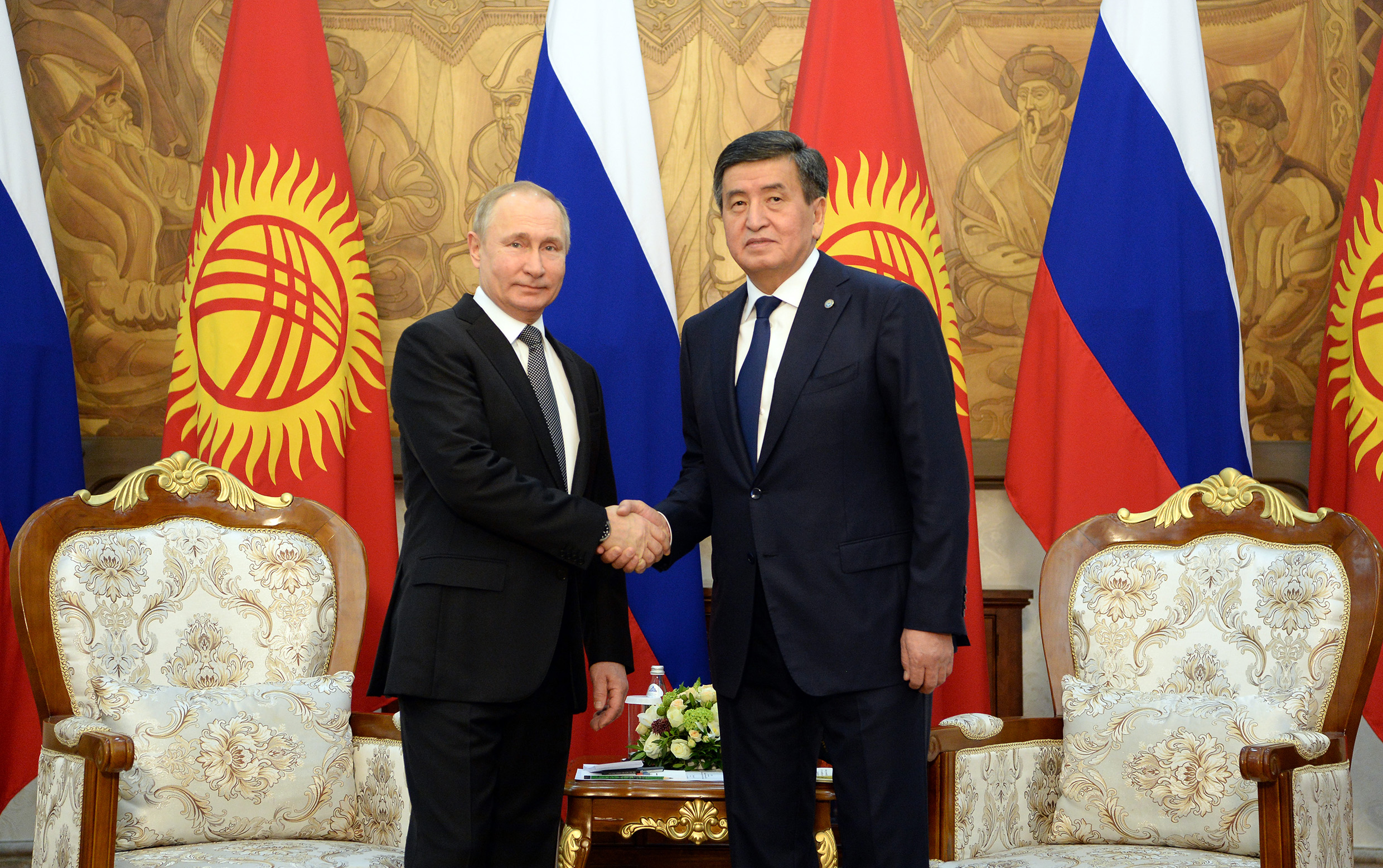
If Vladimir Putin went to Kyrgyzstan to wow his hosts, he more than succeeded.
His single day in Bishkek saw the signing of $6 billion in deals and Russia’s military airbase expanding by an area equivalent to around 70 football fields.

On the day of the visit, on March 28, Kyrgyz Economy Minister Oleg Pankratov offered a breakdown of how that dollar figure was reached.
“In the area of investment, memoranda, agreements and contracts worth $5.6 billion were signed. And provisional export contracts worth $589 million were signed,” he said.
The bulk of that amount — $3.7 billion — were reserved for deals in the power, mineral resources and hydrocarbon sectors. Another $1.3 were in industry. A remaining $450 million were deals to do with agriculture.
To get even more specific, the Kyrgyz state investment agency signed a $1.5 billion memorandum of cooperation with privately owned Moscow-based company Ruselprom.
“This is an agreement on cooperation in the field of hydropower, on the construction of large and small hydropower plants and the assembly of hydropower stations, hydraulic units and other equipment needed specifically for hydropower,” said the head of the state agency, Adilbek uulu Shumkarbek.
This was all a lot, but quite a bit short of the galactic $12 billion forecast volunteered earlier in the day by deputy Prime Minister Zhenish Razakov. Then again, it depends what was being counted, as there was a whole lot of wishful thinking going around.
Kanat Abdykerimov, the head of the Kyrgyz railways, claimed sensationally that his company and Russian Railways were to sign anywhere between $5 billion and $7 billion worth of memorandums of agreements to develop railway networks. Abdykerimov hopefully mentioned the mythical China-Kyrgyzstan-Uzbekistan route and the equally distant-feeling Kyrgyz north-south railroad initiative as areas to be focused upon. Those memoranda do not seem to have materialized and it was hard the shake the notion that Abdykerimov was wildly plucking figures out of the air.
The whole day was just an endless procession of these often notional figures.
So Putin declaimed at a meeting with this Kyrgyz counterpart, Sooronbai Jeenbekov, that Russia has since 2011 annually delivered 1.1 million tons of duty-free oil and oil-based products. The direct economic effect of this preferential treatment, he said, was worth $2 billion.
(As an aside though, it is worth noting that an awkwardly large proportion of Russian exports to Kyrgyzstan is accounted for by oil and oil-based products — 43 percent in 2018, according to Russian Energy Minister Alexander Novak.)