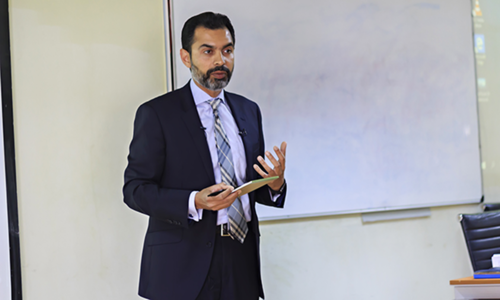
KARACHI: State Bank of Pakistan (SBP) Governor Reza Baqir while addressing a press conference on Monday expressed confidence in the country’s economic future, and provided assurance that the “two main causes of our instability are being effectively addressed in a credible manner”.
Baqir’s press conference comes days after the budget was presented in the National Assembly. In the days leading up to and after the budget, the opposition threatened to take to the streets against rising prices to protest the impact of the Pakistan Tehreek-i-Insaf’s ‘austerity budget’ on the people.


The SBP chief, describing uncertainty as “the biggest opponent” facing the economy, stressed the need to “proceed in a way that eliminates this uncertainty, and our people get the confidence that we have in the SBP, and that I personally have in a positive future.”
He then went on to provide an explanation of how the government is tackling the exchange rate and inflation.
“Our exchange rate regime should be seen as a part of a broader package of economic reforms. There are a lot of influences on our country’s exchange rate policy,” Baqir told reporters.
“In the past, one of the challenges faced by the SBP has been interference by the government. Specifically, when the government wants to borrow money but is unable to secure a loan from a commercial bank, it turns to the central bank. When the SBP finances the government, it has an inflationary effect and puts pressure on the exchange rate,” he explained.
“Under this budget, the government will not borrow from the SBP,” he said, adding that the decision would make an improvement to the exchange rate.
The central bank governor showed off a chart mapping the average quarterly historical exchange rate against the external deficit. “While the [exchange rate] remained fixed for a long time, the [external deficit] began increasing and kept increasing. The development alongside this was that our reserves were depleting,” he said.
“It was not an appropriate policy to keep a fixed exchange rate for long, due to which our situation today has been created.”
The SBP governor said neither a fixed exchange rate ─ as had been in the past ─ nor a free float was appropriate for the economy.
“If the fixed rates are not right, we sustain damage. On the other hand, the free float is not appropriate for us either. In the free float regime, the basic concept is that is solely determined by market forces and the State Bank has no role in it. This policy is not at all okay for us because when the exchange rate is determined, there are some factors which are fundamental, and some which are based on market sentiment. The market sentiment sometimes overtakes the fundamentals, that’s why a free float is not appropriate.”
He went on to say that in light of these realities, the government had adopted a market-based exchange rate system which “we are running on now”.
“In the market-based system, you consider supply and demand factors, what side they are pulling the exchange rate, and you don’t suppress them. And this is fundamental ─ we keep a close eye on the market, and if there is excessive volatility […] or special pressures, the SBP intervenes. And we will continue to do so to make sure that there isn’t excessive volatility or ‘disorderly market conditions’, as economists say,” Baqir clarified.
He explained that the government favoured this regime because “if you take demand and supply factors into account, and the exchange rate takes on market value, that will be best for our exports.”
“Since the exchange rate began moving towards its market value, the imports have decreased and export volumes have recently started increasing,” he said.
He explained that as the exchange rate depreciates, causing imports to fall, it will have an import substitution effect on the local industries which compete with imported goods. “They have more space to compete, and they will be benefited, as will the country.”
Currently, he said, a seasonal pattern of outflows being observed due to yearly closing of accounts by companies has been putting pressure on the exchange rate. “We used to suppress it, but after imposition of the market-based rate, the impact is noticeable,” he said. “The main point is that […] there will be two-way movement [in the exchange rate].”
Explaining the role of the central bank in maintenance of interest rates, Baqir said the banks “try to manage price stability and reduce inflation and create financial stability so that the financial system does not collapse”.
Differentiating between financial stability and exchange rate stability, he said that a lot of emerging markets have found financial stability even as their market-based exchange rate keeps moving around.
“Interest rates in Pakistan are set by an independent body called the monetary policy committee. The mandate is to fight inflation ─ that’s their number one consideration. Along with that, we have a forward-looking manner,” which he said helps the government forecast what inflation is going to be like in the future.
“It is one of the SBP’s key goals to fight inflation, and we will continue to use all the tools at our disposal to fight it,” he added.