CHIBA: Corporate Japan’s growing need to rely on new technologies to cope with the shrinking workforce was on show at the recent CEATEC technology exhibition, with service industry companies turning out in greater numbers this year.
As more and more skilled workers reach retirement across various industries in rapidly graying Japan, businesses are turning to new technologies to hand down field experience and knowledge to younger workers.
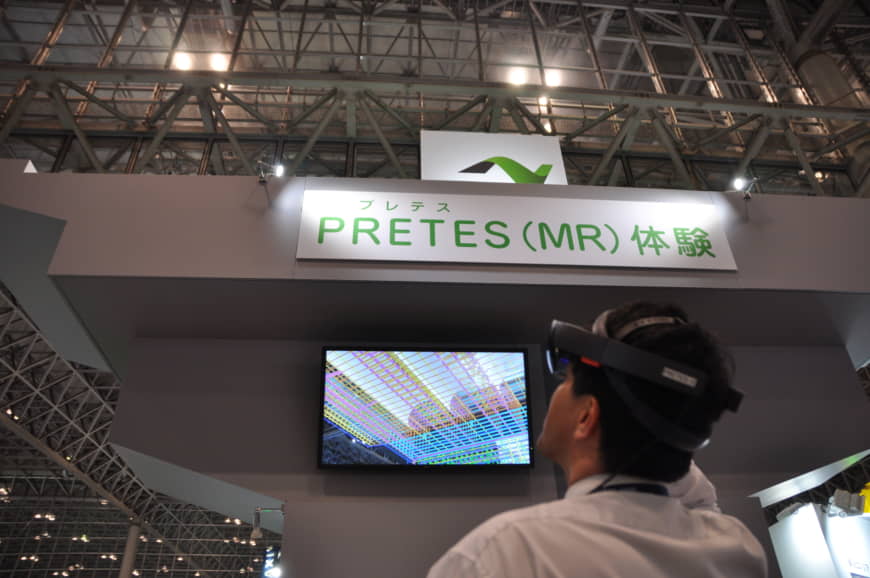
East Nippon Expressway Co., which operates expressways and toll roads, is one company adopting “mixed reality” technology as it seeks to boost training of inspection and maintenance personnel.
“We are increasingly required by the government to conduct checks on roads, but our skilled workers are aging and cannot work at their fullest anymore. So we needed to rely on high tech to share and pass on their know-how to the younger employees,” said Masaki Ishiguro, who is in charge of maintenance at the company also known as Nexco East.
The Tokyo-based company demonstrated its technology for inspecting the interior of infrastructure facilities unreachable by humans during the CEATEC trade fair last week at Makuhari Messe in Chiba.
In the Nexco system, a person wearing a virtual-reality headset equipped with cameras and sensors can “see” the internal structures of bridges and roads, including reinforced steel bars, foundations and cylindrical frameworks.
“It is crucial to understand the inside structures of bridges and roads for maintenance and inspection, and to detect damage and cracks in girders or hollow cavities in lining surfaces of tunnels,” Ishiguro said.
“But making judgments about these structures by solely referring to diagrams on paper is difficult, especially for younger, inexperienced workers. So we have a skilled worker train the employees using the headset. They learn a lot faster and better.”
Previously, skilled workers and younger employees repeatedly conducted training at actual sites. But this is becoming a thing of the past as more skilled inspectors reach retirement age and the number of facilities needed to be checked continues to increase due to aging, Ishiguro said.
ANA Holdings Inc., meanwhile, is going beyond its traditional field as an airline and developing avatar robotics technology in cooperation with other firms and local governments to offer new services.
It has developed an avatar robot called Newme, which has a tablet-sized monitor on a stick-like body that is controlled remotely. The tablet shows the real-time facial expressions of the operator through video.
The airline, also grappling with a shortage of staff, said trainers for flight attendants can give lectures via the Newme robots to employees at multiple locations.
“We can share intelligence and skills instantaneously by using avatar robotics technology,” ANA Holdings CEO Shinya Katanozaka said in a speech at CEATEC, adding that the company is also developing other types of avatars, such as one with a robotic hand.
“For example, a globally acclaimed chef can give lectures on cooking or a top doctor can train those seeking to become doctors simply by connecting him or herself to the avatars located remotely,” Katanozaka said.