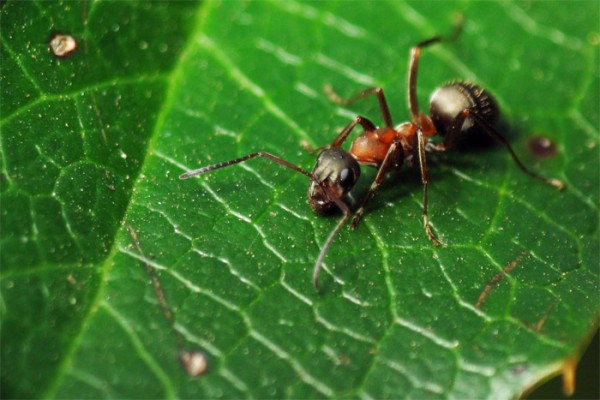


AFRICA: According to the latest research, ants unconsciously turn left than right when search unknown spaces and places.
The study that has been conducted by researchers at the University of Bristol put ants in different experiments to examine their left turning tendency. Edmund Hunt, PhD student at the University of Bristol, who is also the co-author of the study, revealed that ants probably use their right eye to navigate and the left eye to identify predators.
“As their nest-mates are left-leaning too, there should also be safety in numbers. Consistent turning may also help the ants to monitor nest mates during house hunting. So perhaps leaning left is more shrewd than sinister,” says Hunt.
The researchers observed ants belonging to eight separate colonies, while they were exploring a new nest. On 35 occasions the ants turned left when they entered the nest, while on 19 occasions the ants turned right.
The researchers also conducted another experiment where some ants were put in a branched maze. The study found that on 50 occasions the ants turned left in comparison to 30 right turns.
Hunt suggests that the left turning tendency of the ants is based on statistical information and the data collected is enough to establish that ants are inclined to turn left when exploring new surroundings.
Ants are not the only creatures that tend to move in a specific direction. Previous studies have revealed that common cockroach found in the U.S. usually turn to their right when in a Y shape tube. Giant water bugs also turn to their left when in underwater T mazes.
Vertebrates also show tendency of a selecting a specific direction. About 90 percent of all humans are right-handed, while just 10 percent of humans are left-handed.
Experts suggest that regional brain specialization of tasks has been found in many animal species. This brain specialization is also observed to be beneficial as it allows animals to perform two tasks simultaneously without affecting the efficiency of any of the tasks.

Karachi Port sets 138-year cargo handling record
KARACHI: Pakistan's maritime sector has achieved a major milestone as Karachi Port set a new record in its 138-year history...