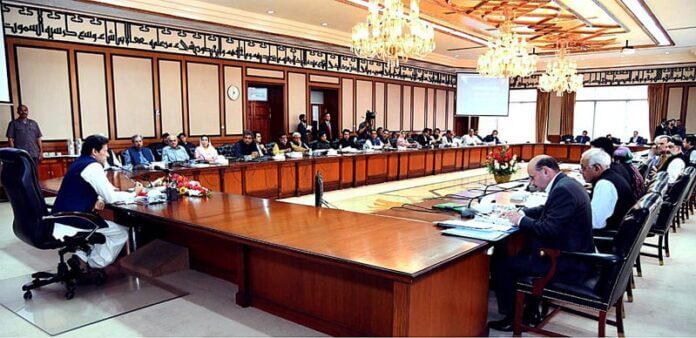
ISLAMABAD: The federal cabinet on Tuesday approved the first-ever National Tariff Policy (NTP) with an aim to institutionalise the entire tariff structure of the country.
“Although the Federal Board of Revenue (FBR) had earlier expressed concerns over the tariff policy drafted by the Ministry of Commerce, it did not object the draft during the cabinet meeting on Tuesday,” said an official, adding that the board was only concerned about revenue, especially on the import side.


“Since Prime Minister Imran Khan was already briefed in this regard, the FBR officials could not resist the tariff policy,” he added, terming it a big achievement of the commerce ministry.
According to the official, the tariff policy would help improve export competitiveness, increase employment opportunities, and ensure a transparent and predictable tariff regime.
Prime Minister Imran Khan, while approving the first-ever NTP, said that the import tariffs were traditionally employed as a revenue generation tool, which was why reliance on import tariffs for revenue collection had increased.
“In accordance with the reform agenda of the government, the economic policy paradigm is now being realigned to leverage tariffs for industrial development,” he added.
According to details, the National Tariff Policy aims to remove all anomalies in the tariff structure and make it a reflection of trade policy priorities. It focuses on the enhancement of competitiveness through duty-free access to imported raw materials and promotion of investment into efficient industries through a predictable tariff structure, decided through an institutional mechanism.
The NTP is based on the principles of (i) employing tariffs as an instrument of trade policy rather than revenue generation, (ii) maintaining vertical consistency through cascading tariff structures (increasing tariff with stages of processing of a product), (iii) providing time-bound ‘strategic protection’ to the domestic industry during the infancy phase, and (iv) promoting competitive import substitution through time-bound protection, which will be phased out to make the industry eventually competitive for export-oriented production.
The policy guidelines contained in the NTP, as approved by the cabinet, provide that the tariff slabs would be simplified based on the principle of cascading; tariffs on raw materials, intermediate and capital goods will be gradually reduced; the additional customs duty and regulatory duties will be gradually reduced; the difference in the rates of tariff for the commercial importers and industrial users of raw materials, intermediate and capital goods will be eliminated to provide a level-playing field to the SMEs through competitive access to essential raw materials; the nascent industry will be provided time-bound protection, which will cover the payback period.
The policy will be implemented through a Tariff Policy Board (TPB) chaired by the commerce minister/adviser, with the minister for industries & production, finance secretary, revenue secretary, FBR chairman, commerce secretary, Board of Investment secretary, and NTC chairman as its members.
A Tariff Policy Centre shall be created in the Ministry of Commerce, which will serve as the Secretariat of the TPB.
Speaking on the occasion, PM’s Commerce Adviser Abdul Razak Dawood stated that the NTP marks a watershed in the country’s economic policymaking since it would energize export growth, lead to rapid industrialization, and import substitution through predictability in tariff framework.