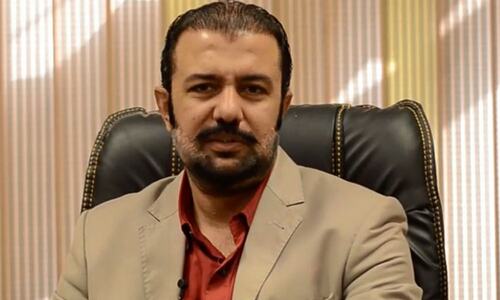
ISLAMABAD: Advisor to the Finance Minister Khurram Schehzad on Friday called on provinces to strengthen tax collection, saying provincial revenues remained stuck at 0.85 percent of GDP, in Fiscal Year 2025, despite vast untapped potential in services, agriculture and property sectors.
“Federal collections are already at 11.3% of GDP and moving toward benchmark levels. Provincial collections, combined, remain at 0.85% of GDP, far below the 3% expectation, despite substantial tax bases in services, agriculture, and property sectors,” the advisor wrote on X while quoting economic data of Fiscal Year Y2025.


He said, even on collection efficiency, the gap is stark as the federal income tax yields exceed 17% of the estimated taxable base. Provincial yields, on the other hand, remain far lower across assigned bases, with agricultural income tax yield being at 0.2%.
“So, the evidence is clear, provincial revenue potential remains largely untapped. Progress demands a balanced reform agenda with a stronger revenue effort at every level. Fiscal federalism and resource allocation should be debated on measured outcomes, not perceptions,” he added.
He said, federal and provincial governments were partners; closing provincial tax gaps, alongside federal reform, was key to better services, lower fiscal stress, and a fairer federation, Schehzad added.
Elaborating on the facts-based comparison, the advisor said the federal tax administration had collected over Rs13 trillion in taxes and levies in FY25, equivalent to 11.3 percent of GDP, placing it on a clear trajectory to reach 15 percent of GDP by June 2028, in line with benchmarks for countries at Pakistan’s level of development.
In contrast, he noted that combined provincial tax collections stood at Rs979 billion in FY25, accounting for just 0.85 percent of GDP, even though provinces were expected to contribute around 3 percent of GDP, implying that collections.
Schehzad stressed that the core issue was not the absence of taxable bases but the low revenue yield from existing bases, pointing out that provinces controlled major tax handles under the Constitution yet continued to underperform significantly. He cited sales tax on services, where the estimated taxable base was Rs29 trillion, but actual provincial collections were only Rs650 billion, or 2.2 percent, compared to federal sales tax on goods yielding Rs3.9 trillion, or 13 percent, from a similar-sized base.
He further highlighted the stark underperformance in agricultural income tax, a provincial subject, where an estimated taxable base of Rs3.7 trillion generated just Rs8.4 billion, translating into a negligible 0.2 percent yield. Property-related taxes also remained weak, with provinces collecting Rs66 billion, or 0.3 percent, from an estimated real estate asset base of Rs21.7 trillion.
Comparing Pakistan with regional peers, the advisor said property tax collections in Pakistan, at 0.08 percent of GDP, lagged behind countries such as Malaysia and the Philippines (0.5 percent), Nepal (0.4 percent), Indonesia (0.3 percent) and India (0.2 percent), underscoring the scale of unrealised provincial revenue potential.
He reiterated that sustainable fiscal reform required stronger provincial revenue mobilisation alongside continued federal reforms, adding that evidence-based policymaking and shared responsibility between the federation and provinces were essential to improve service delivery, ease fiscal pressures and strengthen Pakistan’s federal system.