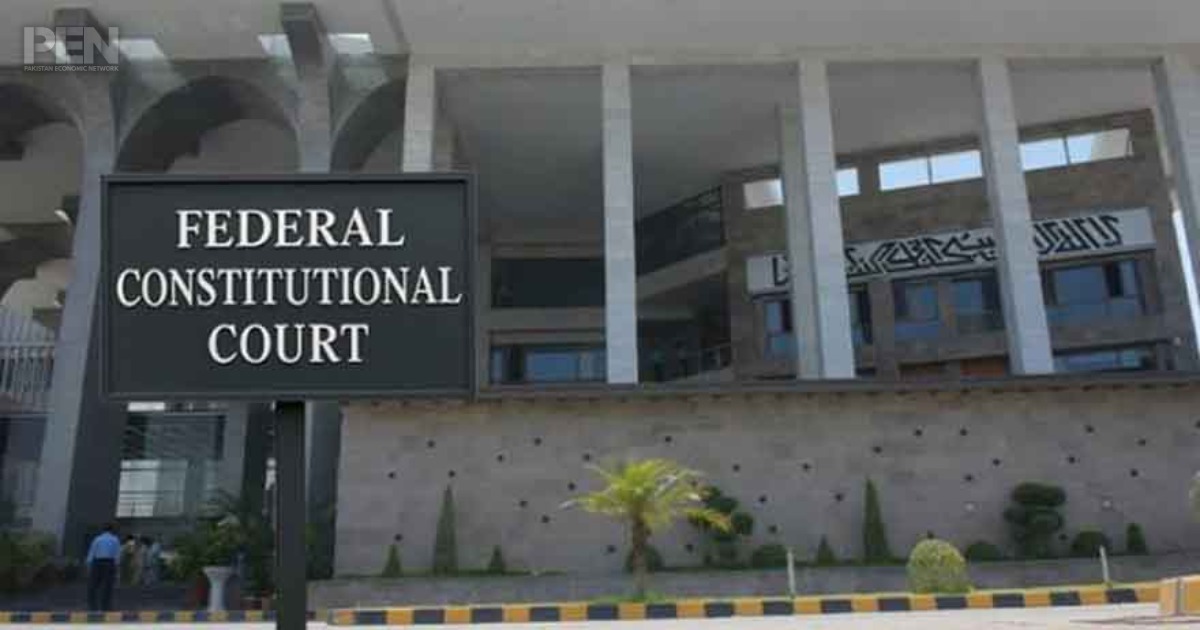
ISLAMABAD: The Federal Constitutional Court (FCC) was informed on Friday that the federal government and the Federal Board of Revenue (FBR), dissatisfied with multiple judgments issued by the Islamabad High Court (IHC) on matters linked to Section 4-C of the Income Tax Ordinance, 2001, have filed several intra-court appeals before the IHC.
The matter was heard by a three-member bench of the FCC headed by Chief Justice Amin-ud-Din Khan. The bench is examining appeals filed by the FBR against decisions of the Sindh, Lahore, and Islamabad high courts concerning the imposition of Super Tax under Section 4-C, which was introduced through the Finance Act, 2022.


Appearing on behalf of the Secretary of the Revenue Division, Hafiz Ahsaan Ahmad Khokhar argued that the objections raised by taxpayer respondents regarding the maintainability of the petitions lacked legal basis. He maintained that these objections were inconsistent with the Constitution and the applicable statutory framework.
Khokhar explained that the appeals were later transferred to the Supreme Court’s constitutional jurisdiction under Article 186-A of the Constitution. Following the enforcement of the 27th Constitutional Amendment, these cases are now pending before the FCC for final determination.
Elaborating on the constitutional scheme, Khokhar emphasized that Article 99 of the Constitution governs the conduct of executive business of the federation. He noted that the provision requires all executive actions to be carried out strictly in accordance with the Rules of Business, 1973, highlighting the central role of procedural compliance in executive decision-making.
He further submitted that under Rule 14-A, read with Entry 35 of Schedule II of the Rules of Business, the Revenue Division and the FBR have exclusive authority over taxation matters. This includes fiscal policy, administration of tax laws, and safeguarding federal revenue. As a result, initiating, pursuing, and defending tax-related litigation falls squarely within the constitutional mandate of the Revenue Division, acting on behalf of the federation.
Khokhar also pointed out that amendments to the Rules of Business, 1973, have removed the requirement for mandatory consultation with the Ministry of Law and Justice or the Office of the Attorney General in revenue matters. He clarified that revenue litigation is expressly excluded from Entry 21 of Schedule II, thereby granting the Revenue Division and FBR complete autonomy in handling such cases.
According to him, once a subject is assigned to a particular division under Rules 3 and 4 of the Rules of Business, that division is fully empowered to take all necessary executive actions to implement the law, including legal proceedings. Imposing compulsory consultation requirements, he argued, would undermine the intent behind the amendments and weaken the efficiency of fiscal administration.
He further stated that the FBR, being an attached department of the Revenue Division under Schedule III of the Rules of Business, derives its authority from both constitutional provisions and statutory laws, including the Federal Board of Revenue Act, 2007. Consequently, actions taken by the FBR and its officers in tax litigation are deemed acts of the federation itself and carry a strong presumption of legality.
Khokhar added that superior courts have consistently held that when executive authority flows directly from the Constitution and the Rules of Business, objections alleging lack of authorization hold no weight unless a clear statutory restriction exists. He cautioned that protection of public revenue should not be obstructed through overly technical objections, particularly where legal remedies are pursued in good faith within the constitutional framework. He is scheduled to continue his arguments on Monday.
Earlier, counsel Asma Hamid pointed out that taxpayers had named relevant Inland Revenue Commissioners as parties in their petitions before various high courts. However, when approaching the Islamabad High Court, they also impleaded the federation as a respondent.
Chief Justice Amin-ud-Din Khan observed that the core objection raised by taxpayer representatives was that the federation is entitled to file appeals only when a federal law is struck down by a high court, and not merely against the issuance of tax notices.
Responding to this, Asma Hamid stated that all high courts had upheld the constitutional validity of Sections 4-B and 4-C. She also referred to a March 2023 order of the Supreme Court, in which taxpayers were directed to deposit 50 percent of the Super Tax amount as a condition for leave to appeal.
She further noted that no taxpayer had challenged the Sindh High Court’s judgment, which declared Section 4-C to be intra vires and applicable from tax year 2022 onwards. Concluding her arguments, she informed the court that her final submissions would be presented on Monday.