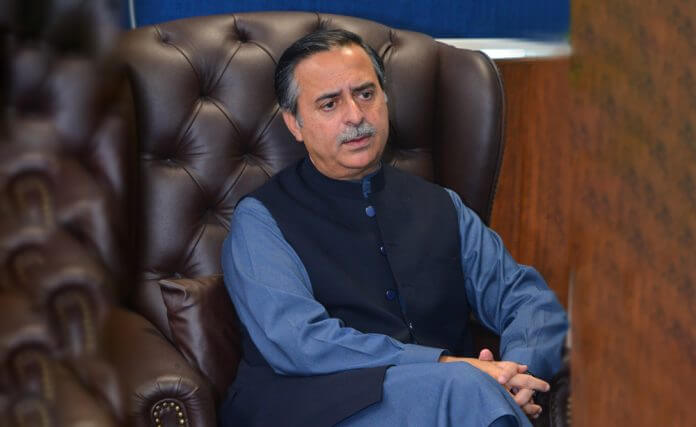
KARACHI: Federal Minister for Maritime Affairs, Junaid Anwar Chaudhry Friday hailed the government’s forward-looking strategy and the exceptional performance of port authorities, stating that surging transshipment activities are breaking records, showcasing Pakistan’s global maritime potential and establishing the country’s ports as premier hubs for trade and commerce.
Junaid Anwar Chaudhry, in an interview with a local media channel noted that the steady growth in transshipment activities has set new milestones which showcased Pakistan’s national capacity and strengthened the country’s ports as thriving centers of commerce and regional connectivity.


The minister highlighted that major ports, including Karachi Port, Port Qasim, and Gwadar Port, along with other Pakistani ports, have achieved record performance. The minister stated that Pakistan utilized around 8,300 transshipment units in 2025, while a new record has already been established within just 24 days, reflecting accelerated growth and improved operational efficiency.
He reaffirmed the government’s commitment to sustaining this momentum in the coming months. He stated that while global markets were facing crises, Pakistan has achieved record performance in the maritime sector. He highlighted that Karachi Port is witnessing a significant surge in transshipment activity, largely driven by regional shipping disruptions in the Arab Gulf, prompting vessels to reroute toward Pakistan.
He noted that the port handled around 8,300 TEUs during 2025, whereas in just the last 24 days, it has already managed 8,313 TEUs surpassing the entire previous year’s volume and demonstrating exceptional growth and operational efficiency.
He said that in order to promote transshipment in Pakistan, the government has increased the overall capacity of ports, with Karachi Port Trust being made functional with a capacity of 20,000 TEUs (twenty-foot equivalent units), Port Qasim Authority with 12,500 TEUs and Gwadar Port Authority with 5,000 TEUs, to handle more containers.
He said that the handling of transshipment cargo has also improved, with 8,000 containers received and 3,500 dispatched at Karachi Port, while 4,500 containers are in balance, while 3,485 containers are present at Port Qasim, indicating the increasing activity of the system.
The government has relaxed the rules and amended the transshipment rules through SRO, under which cargo storage at off-dock terminals has been allowed and the capacity has been increased to 60,000 containers.
To reduce costs, the National Logistics Corporation has announced a 50% reduction in scanning charges, while this discount will be increased to 75% if the ship brings completely transshipment cargo. In addition, terminal operators have also immediately reduced by 25%.
To provide further convenience, the wharfage fee has also been significantly reduced, where this fee has been reduced by 60% for ships bringing transshipment cargo, making Pakistan more attractive to foreign ships.
The minister said the government has introduced modern transshipment facilities, allowing sea-to-air transshipment, while transshipment of RO-RO (roll-on-roll-off) cargo and break-bulk cargo has also been made possible, and sea-to-road transshipment is also under consideration.
The minister further announced that under the government’s vision, three additional ports will be developed, along with the establishment of a modern energy city to support industrial expansion and maritime trade.
He emphasized that these initiatives will enhance foreign investment, create employment opportunities, reduce logistics costs and position Pakistan as a competitive maritime and trade hub in the region, further strengthening its economic outlook and global standing.