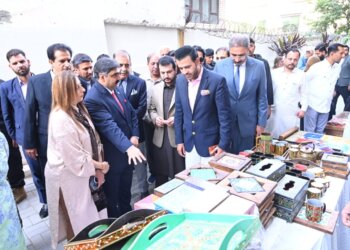
FAISALABAD: Officials from Pakistan Customs have urged exporters to fully utilise the Export Facilitation Scheme (EFS), highlighting that businesses at Faisalabad Dry Port are now receiving the same level of facilitation as those operating in Karachi.
The remarks were made by Collector of Customs Appraisement Faisalabad Dr Rizwan Basharat during an awareness session held at the Faisalabad Chamber of Commerce and Industry (FCCI). He outlined key reforms aimed at simplifying export procedures, improving transparency, and enhancing trade competitiveness.

Dr Basharat said that advanced technologies, including artificial intelligence-based monitoring systems, have been introduced to track container movements and record any opening of export consignments at dry ports. The initiative is designed to strengthen accountability and minimise unnecessary interference in cargo handling.
He also briefed participants on recent amendments to the EFS framework issued through a statutory regulatory order (SRO). Under the revised rules, the mandatory utilisation period for imported goods has been extended from nine months to 18 months, effective from March 18, with retrospective applicability for existing users of the scheme.
The updated system enables real-time automatic adjustment of imported inputs once exports are completed, significantly improving procedural efficiency. Additionally, restrictions on the timing of export of finished goods manufactured from imported materials have been removed, providing exporters with greater operational flexibility.
Under the new framework, EFS licences will now be valid for one year, while any extension beyond the 18-month utilisation period will require approval from the relevant regulatory authority.
Earlier, FCCI President Farooq Yousaf Sheikh welcomed the initiative, stating that the scheme has already enhanced the competitiveness of Pakistan’s textile exporters. He noted that the session aimed to help businesses better understand recent regulatory changes and maximise benefits under the scheme.
Chairman of the Pakistan Hosiery Manufacturers and Exporters Association, Ahmad Afzal Awan, suggested that partially completed export consignments should also be adjusted promptly once production using imported inputs is finalised.
During the interactive session, business representatives, including Muzammil Sultan and Arif Ehsan Malik, shared concerns and proposals, while senior FCCI officials and export sector representatives also participated.
Officials reiterated that the government’s broader objective is to streamline export procedures, reduce compliance costs, and enhance Pakistan’s export competitiveness through regulatory facilitation and technology-driven oversight.