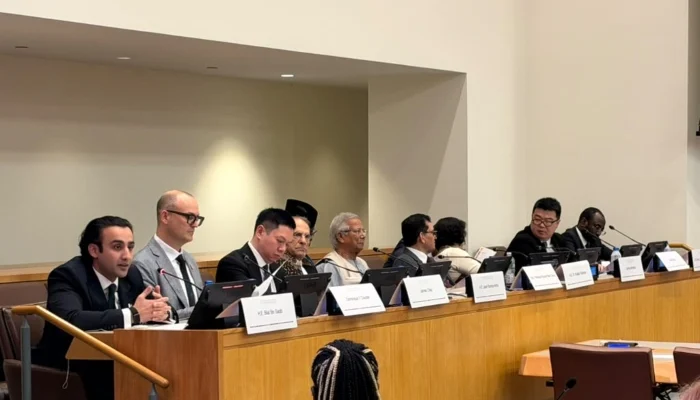
UNITED NATIONS: Pakistan used the platform of the 81st Session of the United Nations General Assembly to argue that artificial intelligence and tokenization can become the developing world’s most powerful engines of financial inclusion, provided they are built for the people the financial system has long excluded.
Minister of State and Chairman of the Pakistan Virtual Assets Regulatory Authority (PVARA), Bilal Bin Saqib, delivered the keynote address at the Social Business, Youth and Technology Forum, held to mark fifty years of microcredit and the Year of Social Business.


The forum’s opening panel included President of the 81st UN General Assembly Dr. Khalilur Rahman, President of Timor-Leste and Nobel Peace Laureate José Ramos-Horta, Prime Minister of Bhutan Dasho Tshering Tobgay, Brazil’s Minister Wellington Dias, and Nobel Peace Laureate Professor Muhammad Yunus, whose work on microcredit the forum was convened to honour.
The keynote situated Pakistan’s own trajectory within a broader global context, noting that an estimated 1.3 billion adults worldwide remain without an account at any financial institution, even though close to 900 million of them already own a mobile phone.
The gap, it was argued, is no longer one of technology but of rails and rules, and of the willingness to build them.
Pakistan was held up as proof that the choice can be made. Having closed its banking system to digital assets in 2018, the country reopened that door with the passage of the Virtual Assets Act 2026, followed by the establishment of a regulatory sandbox and the launch of licensing regulations for virtual asset service providers.
Independent global adoption indices put the number of Pakistani virtual asset users at more than 40 million, among the largest and youngest user bases in the world.
Bin Saqib said the Global South had for too long been treated as a passive participant in global technology and finance, and stressed that Pakistan was now positioning itself as a maker of this technology rather than merely a taker of it.
He added that technology and regulation alone could not deliver inclusion, and that inclusion instead occurs at the point where the two meet.
The keynote closed with a call to young innovators across the developing world to build without waiting, framing the goals of zero poverty and zero unemployment not as distant aspirations but as objectives that today’s tools make achievable.