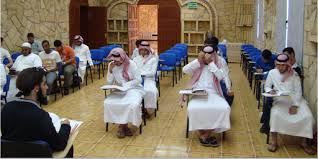
RIYADH: According to a recent report, Saudi schools failed to help students get a grip on mathematics and science. A literacy rate in Saudi Arabia has grown rapidly from 10% in 1960 to 99% currently for children of school-leaving age.
Kingdom allocate greater share of its gross domestic product on education than most wealthy countries. Yet in a recent set of standardized global math tests the Trends in International Mathematics and Science Study under half of Saudi 13year-olds reached the lowest benchmark, compared with 99 % in South Korea and 88% in England.”


Scarcely 1% of the Saudi children tested gained an ‘advanced’ level, against 47% of South Korean and 8% of English ones.”
Saudi schools are not just of generally poor quality, but that they fail to encourage brighter students, report said.
Many students complain that due to heavy attention paid to subjects such as Arabic and Islamic studies Saudi schools fall behind in covering science, technology and other areas.
To deal with challenges in the education system, several Saudi organizations are in favor of hiring expatriates instead of Saudi nationals. However, the government is dealing with the situation by sending its students overseas for further studies.
Recently, Saudi Arabia signed a $1.1 billion contract with colleges in the United States, the UK, Canada and Spain to provide technical training to nationals.
The system requires that every student study identical academic material in the sciences, literature, and math regardless of where a student’s interest lies.
Additionally, the material offered in many of these subjects is extremely lacking; history topics only cover the Islamic era, honors classes are nonexistent, and English classes are only available after the seventh grade at public high schools.
Teachers encourage a method of unproductive memorization and an apparent understanding of facts for the sole purpose of passing a test. This type of education extends far beyond high school to the college and university levels. Students are continuously taught ways to pass an exam rather than the proper approaches to learning.