Customs Today
  • Home
  • Islamabad
  • Karachi
  • Lahore
  • National
  • Transfers and Postings
  • Chambers & Associations
  • Business
No Result
View All Result
Customs Today
  • Home
  • Islamabad
  • Karachi
  • Lahore
  • National
  • Transfers and Postings
  • Chambers & Associations
  • Business
No Result
View All Result
Customs Today
No Result
View All Result
Home Science & Technology Science

Hard drive form space uncoveres hidden magnetic messages in meteorites

byCustoms Today Report
23/01/2015
in Science, Science & Technology
Share on FacebookShare on Twitter

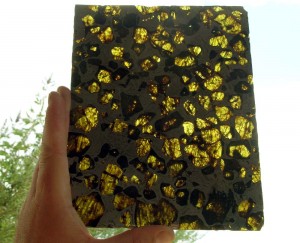
WASHINGTON: A team of scientists led by Richard Harrison from the University of Cambridge, has captured information stored inside tiny magnetic regions in meteorite samples that captures the dying moments of the magnetic field during core solidification on a meteorite parent body, providing a sneak preview of the fate of Earth’s own magnetic field as its core continues to freeze.

Meteorites were previously thought to have poor magnetic memories, with the magnetic signals they carry having been written and rewritten many times during their long journey to Earth. Harrison, however, identified specific regions filled with nanoparticles that were magnetically extremely stable. These “tiny space magnets” retain a faithful record of the magnetic fields generated by the meteorite’s parent body. Harrison and his colleagues could map these tiny magnetic signals using circular polarized X-ray synchrotron radiation at BESSY II. Their results have now been published in Nature.


You might also like

Tesla driverless system to use updated radar technology

12/09/2016

Apple to develop its own self-driving technology

10/09/2016

Meteorites have witnessed a long and violent history; they are fragments of asteroids which formed in the early solar system, 4.5 billion years ago. Shortly after their formation, some asteroids were heated up by radioactive decay, causing them to melt and segregate into a liquid metal core surrounded by a solid rocky mantle. Convection of the liquid metal created magnetic fields, just as the liquid outer core of the Earth generates a magnetic field today. From time to time asteroids crash together and tiny fragments fall to Earth as meteorites, giving scientists the opportunity to study the properties of the magnetic fields that were generated billions of years ago.

“They are like natural hard discs”, Harrison believes. The geologist from the Department of Earth Sciences, University of Cambridge, UK, is searching for methods to decipher the information stored deep inside the space rocks. Now his new approach has yielded its first results.


Tags: Department of Earth SciencesHard drive form spacemeteoritesRichard Harrisonspace uncoveres hidden magnetic messagesUniversity of Cambridge

Related Stories

Tesla driverless system to use updated radar technology

byCT Report
12/09/2016

WASHINGTON: Electric carmaker Tesla announced Sunday it was upgrading its Autopilot software to use more advanced radar technology. In a...

Apple to develop its own self-driving technology

byCT Report
10/09/2016

SAN FRANCISCO: Apple may not become an automaker, but it still wants to develop its own self-driving technology. The iPhone-maker's...

NASA spots slowest known magnetar

byCT Report
10/09/2016

WASHINGTON: Astronomers have found evidence of a magnetar - magnetised neutron star - that spins much slower than the slowest...

‘YouTubers’ outshining old-school television

byCT Report
09/08/2016

SAN FRANCISCO: A media revolution is taking place, and most people over 35 years of age aren’t tuned in. Millennial...

Next Post

China stocks end higher, CSI 300 climbs 0.5%, Shanghai Composite surges 0.6pc

  • Terms and Conditions
  • Disclaimer

© 2011 Customs Today -World's first newspaper on customs. Customs Today.

No Result
View All Result
  • Transfers and Postings
  • Latest News
  • Karachi
  • Islamabad
  • Lahore
  • National
  • Chambers & Associations
  • Business
  • About Us

© 2011 Customs Today -World's first newspaper on customs. Customs Today.