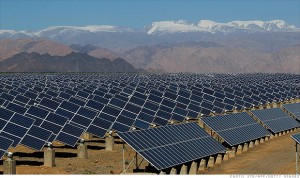
ISLAMABAD: The Alternative Energy Development Board (AEDB) has suggested that a ‘National Electricity Safety Code’ should verify the import process of solar photovoltaic (PV) equipment as second-class such equipment are being imported in the country.
However, sources said that the ministry of water and power wants a mechanism in which no consignment is blocked at the port for want of equipment-testing. So, the draft code is unlikely to be finalised in the near future, and importers in the meantime will take advantage of the situation and import lower-quality PV equipment from China.


Most of the modules are used for water pumps and solar home systems. Pakistan is to have its first large-scale, on-grid PV project as the government plans to install 1GW of PV in the ‘Quaid-e-Azam Solar Park’ near Bahawalpur.
So far, the requirements that a PV plant has to fulfil are defined in a grid code released by the National Electrical Power Regulatory Authority (Nepra). The grid code sets out the guidelines, rules and procedures to be adopted by all grid users.
The German government body Giz, which worked on the renewable energy and energy efficiency, has suggested that all PV equipment should have a product warranty of at least 10 years and a performance guarantee of 90pc at the end of 10 years and 80pc at the end of 25 years.
Giz estimated that since 2011, the import of PV equipment and modules/solar cells has increased constantly. Especially in 2013, a huge amount of modules with a cumulative assessed value of over $108m were imported.
The International Renewable Energy Agency in a 2014 report revealed that biomass, hydropower, geothermal and onshore wind are all competitive with or cheaper than coal, oil and gas-fired power, even without financial support and despite falling oil prices. Solar photovoltaic is leading the cost decline, with a solar PV module’s cost falling 75pc since the end of 2009 and the cost of electricity from utility-scale solar PV falling 50pc since 2010.
Between 2010 and 2014, the total installed costs of utility-scale solar PV systems fell by as much as 65pc. The most competitive utility-scale solar PV projects are delivering electricity at $0.08/kWh without financial support, and lower prices are possible with low financing costs. Their cost range in China, North America and South America has fallen within the range of fossil fuel-fired electricity.