
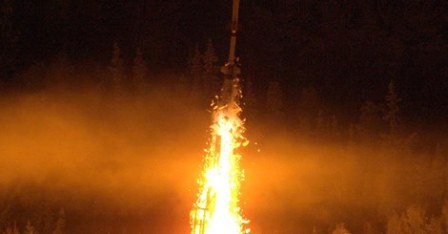
LONDON: Utah State University along with NASA has successfully started a probe into the mystery of northern lights.
The Aurora Spatial Structures Probe (ASSP) was launched at around 5:41 a.m. ET from Poker Flat Research Range close to Fairbanks, Alaska that had been carrying payloads into the Aurora Borealis.


Professor Charles Swenson is the director for the Center for Space Engineering at Utah State and also is the principal investigator for the ASSP mission. He said, “The successful launch of the Auroral Spatial Structures Probe will enable scientists and satellite operators to better understand the energy processes during auroral activity in the thermosphere and its effects on satellites as they orbit Earth. Solar winds produce electric currents in the upper atmosphere where auroral activity occurs, and those currents produce heat that can expand the thermosphere which increases the drag on satellites significantly.”
A large central measuring instrument was launched by the ASSP mission. Six small probes were also ejected from the main instrument in midflight. Each of the small probes has diameter of six inches while it weighs around seven pounds.
Tim Neilsen, ASSP program manager at the Space Dynamics Laboratory (SDL) that is a unit of the Utah State University Research Foundation said, “They are ejected from the rocket in different directions at high velocity, essentially acting as space buoys, to create a network of measurements that will allow us to see the structure of the aurora over a much wider area than was possible before.”
Scientists desire to have more knowledge about the Aurora Borealis. Around four NASA soundings rockets were launched near Fairbanks into the northern lights. They made the effort to better understand as well as visualize turbulent air currents in the upper levels of atmosphere.



