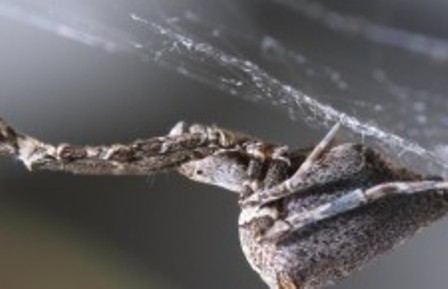
LONDON: Scientists from Oxford University’s Zoology Department are studying how a spider typically found in UK garden centres spins its webs, in order to understand how to manufacture ultra small yet ultra strong fibres.
The feather-legged lace weaver – known to scientists as Uloborus plumpies – uses a unique method for making its webs stick. Unlike a common orb weaver spider, which spins its webs and then coats them with a sticky substance it creates itself from glands on its abdomen, the lace weaver uses static electricity to create stickiness instead.
You might also like


Lace weaver spider silk is remarkably small. While most spiders create webs with silk that can be measured on the micrometer scale, lace weavers instead spin silk threads that are only measurable on the nanoscale. The unique silk is made in the cribellum, an organ that consists of a pair of plates studded with an array of incredibly small nozzles. The cribellum sends the raw silk through very narrow and long ducts before it exits the nozzles; as it does so, the spider uses specialized hairs on hits hind legs to comb the threads, creating an electrostatic charge. Between the static electricity and the incredibly fine size of the silk, the spider’s webs gain the same kind of adhesion properties that other spider species do as well.
The newly-discovered method might have some serious implications for the creation of polymers, according to science experts such as the Verge’s Arielle Duhaime-Ross. She remarks that the techniques may even aid scientists looking to find ways to create their own version of the incredibly sticky nanoscale spider silk.
Scientists have been pursuing ways to recreate the properties of spider silk in laboratory environments for many years. The relative strength of the stuff, in comparison to its size, is thought to have any number of real world applications such as bandages, rope, or even bullet-resistant body armor. Some scientists have even used genetic sequencing to modify goats to secrete spider silk proteins in their milk as a more viable way to harvest the material in greater volumes.