Customs Today
  • Home
  • Islamabad
  • Karachi
  • Lahore
  • National
  • Transfers and Postings
  • Chambers & Associations
  • Business
No Result
View All Result
Customs Today
  • Home
  • Islamabad
  • Karachi
  • Lahore
  • National
  • Transfers and Postings
  • Chambers & Associations
  • Business
No Result
View All Result
Customs Today
No Result
View All Result
Home Science & Technology Science

Astronomers observe black hole choking on a Star

byCustoms Today Report
30/01/2015
in Science, Science & Technology
Share on FacebookShare on Twitter

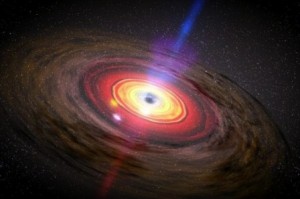
MEXICO: In 2009, a very bright flash of light was caught by the ROTSE IIIb telescope, sparking confusion as to its origin. Now, a paper in The Astrophysical Journal proposes that the event was the death throes of a star being swallowed by a black hole. However, the consumption is proving unusually difficult for the black hole.

On January 21, 2009, the ROTSE IIIb telescope at McDonald caught the flash of an extremely bright event. The telescope’s wide field of view takes pictures of large swathes of sky every night, looking for newly exploding stars as part of the ROTSE Supernova Verification Project (RSVP). Software then compares successive photos to find bright “new” objects in the sky – transient events like the explosion of a star or a gamma-ray burst.


You might also like

Tesla driverless system to use updated radar technology

12/09/2016

Apple to develop its own self-driving technology

10/09/2016

With a magnitude of -22.5, this 2009 event was as bright as the “superluminous supernovae” (a new category of the brightest stellar explosions known) that the ROTSE team discovered at McDonald in recent years. The team nicknamed the 2009 event “Dougie,” after a character in the cartoon South Park. (Its technical name is ROTSE3J120847.9+430121.)

The team thought Dougie might be a supernova, and set about looking for its host galaxy (which would be much too faint for ROTSE to see). They found that the Sloan Digital Sky Survey had mapped a faint red galaxy at Dougie’s location. The team followed that up with new observations of the galaxy with one of the giant Keck telescopes in Hawaii, pinpointing the galaxy’s distance at three billion light-years.

These deductions meant Dougie had a home – but just what was he? Team members had four possibilities: a superluminous supernova; a merger of two neutron stars; a gamma-ray burst; or a “tidal disruption event” – a star being pulled apart as it neared its host galaxy’s central black hole.


Related Stories

Tesla driverless system to use updated radar technology

byCT Report
12/09/2016

WASHINGTON: Electric carmaker Tesla announced Sunday it was upgrading its Autopilot software to use more advanced radar technology. In a...

Apple to develop its own self-driving technology

byCT Report
10/09/2016

SAN FRANCISCO: Apple may not become an automaker, but it still wants to develop its own self-driving technology. The iPhone-maker's...

NASA spots slowest known magnetar

byCT Report
10/09/2016

WASHINGTON: Astronomers have found evidence of a magnetar - magnetised neutron star - that spins much slower than the slowest...

‘YouTubers’ outshining old-school television

byCT Report
09/08/2016

SAN FRANCISCO: A media revolution is taking place, and most people over 35 years of age aren’t tuned in. Millennial...

Next Post

EU pledges 9m euros for 5-yr reform: World Bank offers $50m loan for Sindh tax collection

  • Terms and Conditions
  • Disclaimer

© 2011 Customs Today -World's first newspaper on customs. Customs Today.

No Result
View All Result
  • Transfers and Postings
  • Latest News
  • Karachi
  • Islamabad
  • Lahore
  • National
  • Chambers & Associations
  • Business
  • About Us

© 2011 Customs Today -World's first newspaper on customs. Customs Today.