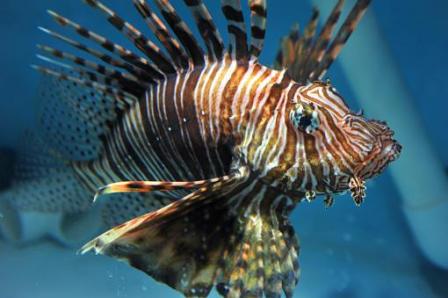

MEXICO: An invasive lionfish has been caught off the coast of Brazil, indicating that these fish have now spread beyond the Caribbean and could threaten coral reefs elsewhere.
A group of researchers used genetic analysis to show a lionfish, caught with a hand spear by recreational divers, is related to the Caribbean population of invaders.
The lionfish seem to particularly enjoy eating critically endangered Caribbean reef fish, so news of lionfish in Brazilian waters raises alarm for Atlantic reefs and the region’s already-threatened marine life.
Lionfish are prolific breeders made famous for threatening reef ecosystems outside their native Indo-Pacific distribution. Though the exact cause of their initial Atlantic invasion is unknown, experts believe aquarium dumping in the mid-1990s is at least partly to blame.
The researchers say the individual found in Brazil probably reached those waters via natural long-distance larval dispersal. It is estimated that one female lionfish can spawn more than two million eggs per year.
“For the past 20 years, invasive lionfishes have been restricted to the Caribbean,” said study author Luiz Rocha from the California Academy of Sciences.
“This new record shows us that lionfishes are capable of reaching far into other areas of the Atlantic, and other countries should be on guard.”
He added: “Without natural predators, lionfishes are ‘top dogs’ on the reef. They can easily pick off small, naive reef fish, and do so with gigantic appetite.”
Previous studies from Mr Rocha and others concluded that many Caribbean reef fish share biological traits, including small size, schooling, and hovering behaviour, that make them a target for invasive lionfish. Brazilian reef fish with small ranges and analogous traits face similar risks in the face of new lionfish invasions.

Tesla driverless system to use updated radar technology
WASHINGTON: Electric carmaker Tesla announced Sunday it was upgrading its Autopilot software to use more advanced radar technology. In a...