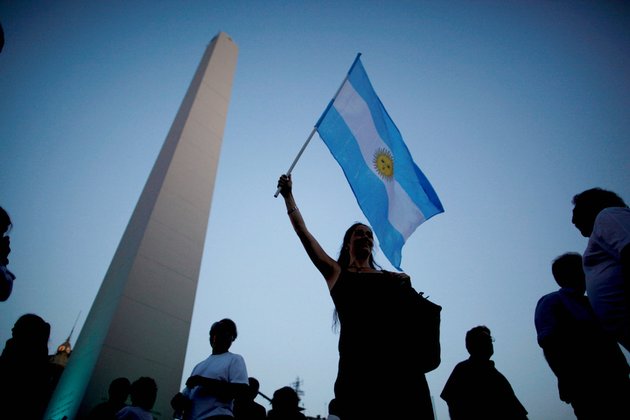
BUENOS AIRES: The economy expanded 2.2 percent in May, compared with the same month a year earlier, the biggest monthly increase in 17 months, mainly thanks to higher domestic consumption and a growth in the construction and agricultural sectors, according to the INDEC statistics bureau.
The last time the country experienced such a high economic growth was in December 2013, when the monthly EMAE economic activity index, a close proxy for gross domestic product, registered a 2.7 percent increase, on the year.

Compared to April, the economy grew 0.8 pacercent, the highest monthly increase so far this year.
The positive figures come after the World Bank and the International Monetary Fund (IMF) both improved their outlook for the Argentine economy this year. The government expects the economy to grow 2.8 percent this year, according to the 2015 Budget.
Continuing signs that an economic recovery is taking hold could end up being a boost to ruling party presidential candidate Daniel Scioli, who already leads the pack of presidential contenders in polls.
“Two weeks before the primary election on 9 August, the economy continues to grow gradually and inflation remains stable, below two percent a month,” consultancy group EF Thomsen said in a briefing note yesterday.
Despite lower global commodity prices, the record harvest reported this year is one of the main reasons behind the economic growth of recent months. A record 118.7 million tons will be harvested this year, historically the highest amount and 11 percent higher than last year, according to a recent report by the Agriculture Ministry.
More than 98 percent of the soy crops have already been harvested, with the total expected to reach 61 million tons this season, 14.2 percent more than last year. About 20.1 million hectares were harvested, 1.6 percent more than in the previous season.
Alongside the positive outlook for the agricultural sector, domestic consumption is also increasing its growing trend. Sales in supermarkets rose 7.5 percent in May compared to the same month last year and 4.2 percent compared to April, while sales in shopping malls rose 9.3 percent and 0.3 percent compared to April. Consumption was encouraged by the Ahora 12 (Now 12) government plan, which finances payments in installments.
A positive performance from the construction sector has also helped produce the positive economic figures. The sector saw a 7.2 percent growth in May compared to the same month last year and accumulates an increase of six percentage points so far this year after five consecutive months of positive figures. A total 424,123 workers were employed in the month, representing a 4.8 percent increase.
The stable path is likely to continue considering 48.8 percent of construction sector businessmen see no changes in the activity level, while 26.8 percent expects a larger growth, according to a survey carried out by INDEC. Sales of concrete rose 8.3 percent, followed by hollow bricks (7.9 percent) and paint (2.8 percent).
On the flip side, the industrial sector has not been able to revert months of decline, dropping 0.9 percent in May compared to the same month last year and rose 0.2 percent compared to April. On the first five months of the year, the sector has accumulated a 1.7 percent drop and 22 consecutive months with negative figures.
Vehicle output dropped nine percent in May compared to the same month last year and accumulates a 15.8 percent decline so far this year. A lower domestic demand and fewer exports to Brazil largely explain the drop. Meanwhile, the iron and steel industry dropped 13.5 percent in May due to a 13.5 percent decline on steel and a 3.2 percent drop on aluminum. The sector accumulates a 9.4 percent drop since January.
Improved outlook
The World Bank predicted the country’s GDP will grow 1.1 percent this year — a considerable upgrade from the decline of 0.3 percent it expected in January — and perhaps even stronger growth of 1.8 percent in 2016 and of three percentage points in 2017, thanks to a “stronger” macroeconomic environment and “regained” access to international capital markets.
“In Argentina, modest growth was led by government consumption, while double-digit inflation rates weighed on private consumption, and weak soy bean prices dented export earnings. A sovereign rating downgrade dampened investor confidence,” said the World Bank in a report released last month.
Meanwhile, the International Monetary Fund said earlier this month that the country will grow 0.1 percent in 2015 and will remain stagnant in 2016. The figures for this year signify an increase from April projections that foresaw a 0.3 percent drop.
Explaining the improved outlook for this year, the IMF said the economy registered higher growth than expected by the IMF in the last quarter of 2014. The government has increased public expenditure more than initially expected, which has led to a growing demand and higher economic growth, the report said.