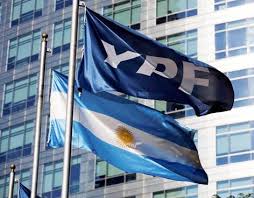

BUENOS AIRES: Argentina’s state-run energy company YPF plans to ramp up unconventional natural gas production to help close the nation’s supply deficit and expand petrochemical output.
“Fifteen percent of our gas production comes from tight and shale,” CEO Miguel Galuccio said late Thursday at the Argentina Oil & Gas Expo in Buenos Aires. “We have a goal of getting 50% of our gas production from these formations by 2020.”
YPF is producing gas from tight plays like Lajas and Mulichinco, as well as from Vaca Muerta, one of the world’s most promising shale plays that has attracted the attention of majors like Chevron, ExxonMobil and Shell.
At El Orejano, a block it is developing in partnership with Dow Chemical, horizontal wells are “showing better-than-expected results,” Galuccio said.
Argentina has 802 Tcf of shale gas resources, far more than its 12 Tcf of proved conventional reserves, according to the US Energy Information Administration.
There is room to meet domestic demand, given that the country is running a deficit in gas, which meets 50% of national energy demand.
Gas production has dropped by about 20% to 118 million cu m/d over the past decade, led by maturing output from conventional reserves.
This has left slack capacity on pipelines that can be filled without much infrastructure investment.
Galuccio said another incentive is that the government is subsidizing gas prices from new developments to encourage exploration and production. Producers get $7.50/MMBtu at the wellhead for such new output, more than a $4/MMBtu average for conventional production.
As the country pays about $7.50/MMBtu or more for imported gas in its liquefied form, there is an incentive to close the deficit with local production, he said, more so if global gas prices rise in the future.
PETROCHEMICAL PLANS
With more gas supplies, YPF wants to expand its petrochemical production.
“There is an important opportunity to create a regional hub for petrochemical production in Argentina,” led by polyethylene, polypropylene and other polyolefins and derivatives, Galuccio said.
“This will make it possible to replace imports and become a net exporter of petrochemicals,” he said.
In August, YPF announced plans to buy stakes in two polymer producers in Argentina for $122 million by the end of 2015. The assets include an 180,000 mt/year polypropylene plant and another with 130,000 mt/year of capacity.
Galuccio said the petrochemical output will add between $1/MMBtu and $2/MMBtu to the revenue the company makes on its gas production.
With this additional revenue, YPF could widen its exploration and production to riskier locations that it can’t develop now because gas prices are not high enough, he said.
YPF produces 45 million cu m/d of gas, more than a third of national output.

Afghan relations Pakistan still wants to rub shoulders despite allegations
KABUL: Despite all the rampant allegations propagated by Afghanistan regarding the use of Pakistani soil to foment terror in the...