Customs Today
  • Home
  • Islamabad
  • Karachi
  • Lahore
  • National
  • Transfers and Postings
  • Chambers & Associations
  • Business
No Result
View All Result
Customs Today
  • Home
  • Islamabad
  • Karachi
  • Lahore
  • National
  • Transfers and Postings
  • Chambers & Associations
  • Business
No Result
View All Result
Customs Today
No Result
View All Result
Home Science & Technology Science

Astronomers capture 1st image of forming planet

bySana Anwar
25/11/2015
in Science, Science & Technology
Share on FacebookShare on Twitter

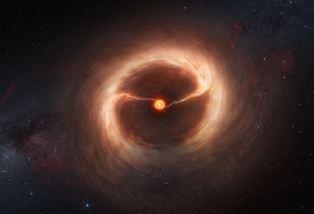
WASHINGTON: In a first, astronomers have captured the photo of a planet in making, located in a star 450 light years away from Earth.

Researchers at the University of Arizona in US imaged the picture of the planet residing in a gap in LkCa1’s disk, despite the disk’s considerable distance from Earth and its gaseous, dusty atmosphere.


You might also like

Tesla driverless system to use updated radar technology

12/09/2016

Apple to develop its own self-driving technology

10/09/2016

LkCa15 is a young star with a transition disk around it, a cosmic whirling dervish, a birthplace for planets.

Protoplanetary disks form around young stars using the debris left over from the star’s formation. Planets then form inside the disk, sweeping up dust and debris as the material falls onto the planets. A gap is then cleared in which planets can reside.

“This is the first time that we’ve imaged a planet that we can say is still forming,” said Steph Sallum, a graduate student at the University of Arizona, who led the research.

Of the roughly 2,000 known exoplanets – planets that orbit a star other than our Sun – only about 10 have been imaged, and that was long after they had formed, not when they were in the making.

Due to atmospheric turbulence, the mixing of hot and cold air, capturing sharp images of distant objects is difficult.

“When you look through the Earth’s atmosphere, what you’re seeing is cold and hot air mixing in a turbulent way that makes stars shimmer,” said Laird Close, an astronomy professor at the University of Arizona.


Related Stories

Tesla driverless system to use updated radar technology

byCT Report
12/09/2016

WASHINGTON: Electric carmaker Tesla announced Sunday it was upgrading its Autopilot software to use more advanced radar technology. In a...

Apple to develop its own self-driving technology

byCT Report
10/09/2016

SAN FRANCISCO: Apple may not become an automaker, but it still wants to develop its own self-driving technology. The iPhone-maker's...

NASA spots slowest known magnetar

byCT Report
10/09/2016

WASHINGTON: Astronomers have found evidence of a magnetar - magnetised neutron star - that spins much slower than the slowest...

‘YouTubers’ outshining old-school television

byCT Report
09/08/2016

SAN FRANCISCO: A media revolution is taking place, and most people over 35 years of age aren’t tuned in. Millennial...

Next Post

Australian stocks decline by break, S&P 200 retreats 24.4pts

  • Terms and Conditions
  • Disclaimer

© 2011 Customs Today -World's first newspaper on customs. Customs Today.

No Result
View All Result
  • Transfers and Postings
  • Latest News
  • Karachi
  • Islamabad
  • Lahore
  • National
  • Chambers & Associations
  • Business
  • About Us

© 2011 Customs Today -World's first newspaper on customs. Customs Today.