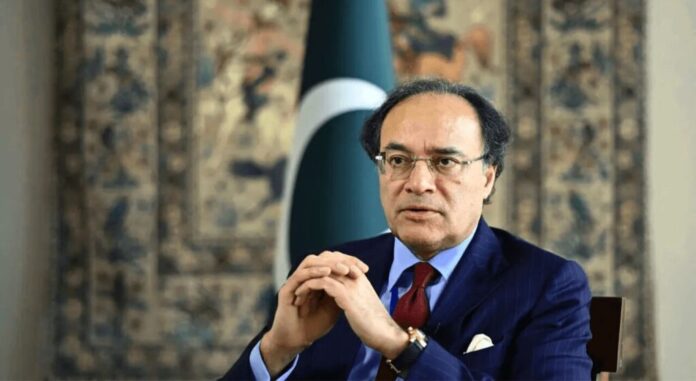
ISLAMABAD: Finance Minister Muhammad Aurangzeb on Saturday departed for the US to participate in the World Bank Group and International Monetary Fund Spring Meetings 2026, during which he is expected to participate in over 50 high-level engagements, the Ministry of Finance said.
The Spring Meetings, set for April 13–18 in Washington, DC, will bring together finance ministers, central bank governors, policymakers and development experts from across the globe at a time of heightened economic uncertainty.


As per the press statement, during his visit, the finance minister will “represent Pakistan at important events organised by the IMF and the World Bank Group”.
It said that Aurganzeb is set to “participate in a wide range of multilateral and bilateral engagements with global financial leaders, development partners, and policymakers” during the course of his visit.
The statement said that before the meetings, the finance minister will visit Boston to participate in the “Pakistan Conference at Harvard University”.
At the conference, he is expected to engage with “leading academics, policymakers, and members of the Pakistani diaspora, and share Pakistan’s economic outlook, reform trajectory, and growth prospects”.
On the sidelines of the Spring Meetings, the finance czar will hold bilateral engagements with Managing Director (Operations), WB Group, Anna Bjerde; Managing Director, International Finance Corporation (IFC), Makhtar Diop; and Managing Director, Multilateral Investment Guarantee Agency (MIGA), Tsutomu Yamamoto.
During the visit, he will also meet the senior IMF leadership, including First Deputy Managing Director Dan Katz, Deputy Managing Director Nigel Clarke, and Director of the Middle East and Central Asia Department Jihad Azour.
At the meetings, he will discuss Pakistan’s “macroeconomic outlook, reform progress, and future cooperation”.
The finance minister will also hold engagements with the US administration, including meetings with senior officials from the US State Department and the US Department of the Treasury.
He will also meet the United States Trade Representative (USTR) Jamieson Greer, the statement said, outlining that the objective of the meetings was to “further strengthen bilateral economic cooperation and discuss support for Pakistan’s reform agenda”.
The ministry further stated that Aurganzeb is set to engage senior representatives from global financial institutions, including Franklin Templeton, Rothschild & Co., Citibank, and JP Morgan Chase, as well as representatives of leading technology and policy platforms.
Elaborating on the finance minister’s bilateral engagements, the ministry said that he will meet “key counterparts and financial leaders” from partner countries, including China, Saudi Arabia, the United Arab Emirates, Türkiye, and the United Kingdom.
The statement added that Aurangzeb will engage with “multilateral and development finance stakeholders, including the International Fund for Agricultural Development (IFAD), the Gates Foundation, and senior representatives of institutions such as the Asian Development Bank (ADB), JICA and the Asian Infrastructure Investment Bank (AIIB)”.
During his visit, the finance minister is also expected to take part in a series of multilateral forums, including the “G-24 Finance Ministers and Central Bank Governors’ Meetings “ and the Coalition of Finance Ministers for Climate Action”.
The statement added that he will also contribute to a series of high-level roundtables, policy discussions, and investment forums during his visit.
He is also expected to interact with “global credit rating agencies, including Fitch Ratings, Moody’s, and S&P Global”.
The statement further added that he will also speak to the US-Pakistan Business Council and address the Atlantic Council.
“Over the course of his visit, the finance minister is expected to participate in over 50 high-level engagements,” the statement read.
It added that the visit “underscores Pakistan’s commitment to macroeconomic stability, structural reforms, and strengthening partnerships with international financial institutions and global stakeholders to achieve sustainable and inclusive economic growth”.