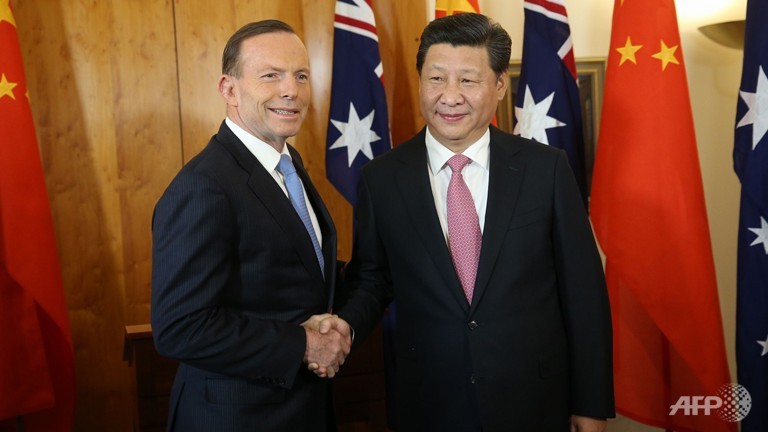
SYDNEY: Australia and China are set to sign multi-billion dollar free trade agreement on Monday during a visit by president of Xi Jinping. Agriculture Minister Barnaby Joyce refused to reveal details of the deal but said he was confident it would be very well received.
The FTA would boost agricultural exports and help counter the downturn in mining which hurts the Australian economy.

Australian financial services providers would have access to China second only to that of providers in Hong Kong and Macau, both part of China.
This would include sectors such as banking, securities, futures and insurance, the daily said.
The Sydney Morning Herald said the deal should open up “billions of dollars in new markets for Australian exporters”.
It would allow dairy farmers tariff-free access to China s lucrative infant formula markets without restrictive safeguard caps that apply to New Zealand.
Existing 30 percent tariffs on Australian wine sold to China would be eliminated over four years, the Herald said.
China is Australia s biggest trading partner, with the two-way flow exceeding Aus$150 billion (US$131 billion).
The trade talks began in 2005, but stalled last year over agriculture and China s insistence on removing investment limits for state-owned enterprises.
Over the past year Australia has sealed free trade deals with Japan and South Korea.
With China s insistence on removing investment limits for state-owned enterprises, the two sides have struggled to seal agreement with Beijing since talks began in 2005.
Xi was due to address the Australian parliament in Canberra on Monday afternoon.
Parliamentary Secretary to the Prime Minister Josh Frydenberg told ABC radio the FTA would prove “a game-changer” and be worth up to $18 billion to the Australian economy over the next few years.
“It will supercharge our trade with China,” he said. “Up to 95 per cent of our exports over time will enter the Chinese market tariff free.”China sought greater access to invest in Australia, Frydenberg added.The FTA is expected to cover an array of issues, including agricultural tariffs and quotas, manufactured goods, services, temporary entry of people and foreign investment.
Last week, Canberra unveiled a deal to ship to China one million Australian cattle worth Aus$1 billion (US$860 million) in an agreement that will double the size of the live export industry.