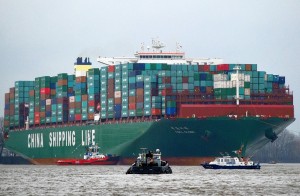
WELLINGTON: The big container ships that ply the world’s trade routes are growing ever larger, holding down the cost of ocean shipping, but also raising concerns among vessel operators, insurers and regulators about the potential for catastrophic accidents.
The ships, designed to carry freight stowed in large metal containers, transport much of the world’s seaborne cargo, including manufactured goods and, increasingly, farm products. Their increasing size already is straining the unloading resources at some port facilities and—along with labor troubles—has contributed to major traffic snarls at the nation’s West Coast ports. Since the economic downturn, shipping lines have sought to stay competitive by running larger, more fuel-efficient container ships in major shipping lanes, reducing their cost per container, according to Noel Hacegaba, acting deputy director of the Port of Long Beach, Calif.


Today, the newest and biggest container ships can carry around 18,000 twenty-foot-equivalent units—the industry’s capacity benchmark—but Dr. Hacegaba said in a study last year that industry watchers expect ships as large as 22,000 TEU to come into service by 2018, and that 24,000-TEU vessels are on the drawing board. The larger ships will further test the capacity of ports and canals and the skill of their captains and crews. “There is a world-wide shortage of qualified seamen to command these vessels,” said Andrew Kinsey, senior marine risk consultant at insurer Allianz SE’s Allianz Global Corporate & Specialty unit and a retired ship’s captain. Capt. Kinsey added that human error is a factor in most shipping accidents.
With bigger ships, the risks are magnified. “The bigger the ship, the bigger the challenge,” said Nick Brown, marine communications manager at Lloyds Register. Losses from the mysterious sinking of the 8,000-TEU MOL Comfort in 2013 imply a cost of more than $2 billion for the similar loss of a new-generation container vessel, according to reinsurance adviser Willis Re. The Comfort, which was only half full, went down off the coast of Yemen after it split in half. “A new ship, five years old, breaking in two, and not in severe sea states, raises concerns,” said Sean Dalton, head of marine for North America at reinsurer Munich Re. Insured losses from the Comfort disaster totaled $523 million, including about $83 million for the hull and $440 million for the cargo, according to estimates cited by Allianz.
A collision of two ships delayed traffic through the Suez Canal last September. Though the blockage was rapidly cleared and didn’t have much impact on costs, it illustrated what could happen. With much bigger ships, which offer less margin for error, the impact could have been much worse. “I would compare it to driving a giant SUV like a Ford Explorer or Suburban, versus driving a midsize car. It is probably OK on the highway, but on a small, local road, with two cars passing, size becomes a challenge. There are fewer areas you can go with the vessels, and they are more susceptible to effects of wind and wave,” said Munich Re’s Mr. Dalton.
Also, not all ports can accommodate big ships, so the risk is concentrated among the few major ports that can. Insurers expect that risk to trickle down as bigger ships displace smaller ones at these ports and smaller ships are redeployed to replace vessels with even less capacity.